Focus this week

A moss terrarium with a glass cover showing condensation
Headline

The Humidity and Airflow Balance Nobody Explains Properly

Closed terrariums are sold as maintenance-free, which is true only when the humidity and airflow balance is right from the start. This guide explains what condensation is actually telling you, how to read a vessel morning and evening, when to ventilate and for how long, why persistent fogging is a lighting problem as often as a water problem, and how to correct a build that is either drowning or drying without tearing it apart.

Rowan Achterberg · 27 July 2026

Moss terrarium built around a sloping substrate and a piece of deadwood
Also in focus

Reading the Slope: How to Plan Depth in a Small Moss Terrarium

Depth is the single quality that separates a jar of moss from a landscape. This long-form guide walks through the substrate slope, the three-plane rule, the way foreground grain size controls perceived scale, and the small tricks — hidden risers, receding textures, a cooler colour temperature at the back — that make a twenty-centimetre vessel read like a hillside. It closes with a slope-planning worksheet you can sketch before you buy a single handful of moss.

Sections

Seven reading rooms, each written for a different part of the craft.

Most read this week

  1. 1
  2. 2
  3. 3
  4. 4
  5. 5

Collections

Latest

Bonsai tree in a shallow pot with a moss-covered soil surface
Ecology & Advanced

Moss and Bonsai: Borrowing from a Neighbouring Craft

Bonsai growers have been managing moss on the surface of a pot for centuries, under conditions far harsher than any terrarium: shallow substrate, frequent drying, strong light and constant handling. Their solutions are practical, well tested and almost entirely unknown to terrarium builders. This guide covers what bonsai practice does with moss, which of its methods transfer indoors, and where the two crafts genuinely disagree.

Moss growing across the face of an old stone wall

Going Vertical: Moss on Walls, Risers and Stone Faces

Most planted vessels use only their floor, which wastes the majority of the volume and produces a composition that reads as a plate rather than a place. Vertical surfaces — stone faces, cork backs, risers and the rear glass itself — are where a small build gains depth. This guide covers which mosses climb, how to attach them, what holds moisture on a vertical face, and how to avoid the slump that ruins most first attempts.

Japanese garden with an extensive moss ground layer beneath trees
Scene Notes

Japanese Moss Gardens and What They Teach Indoor Growers

The moss gardens of Kyoto are the most sustained body of practical moss knowledge anywhere, developed over centuries by people who were never trying to make terrariums. Their techniques do not transfer wholesale to a sealed jar, but their principles transfer completely, and several of them run directly against what indoor guides usually recommend. This feature looks at what those gardens actually do and what a desktop grower can take from it.

Sphagnum moss growing in a damp, humid environment
Ecology & Advanced

Moss, Humidity and the Room Around It

Every planted vessel sits inside a much larger and much less stable system: your home. Room humidity, air changes, heating and even where people sit all shape what happens behind the glass, and understanding that exchange explains a great many otherwise baffling terrarium problems. This guide covers vapour pressure deficit in plain terms, how indoor humidity really behaves across a year, and what a small vessel can and cannot do to the room.

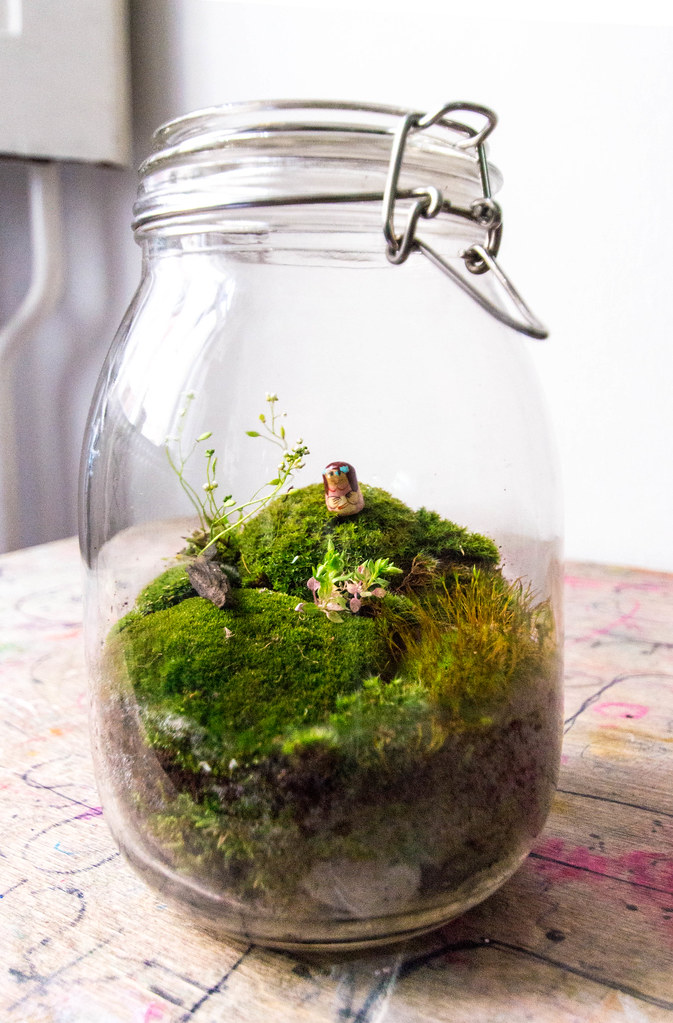
Sealed glass jar terrarium containing moss and small plants
Build Teardowns

Eighteen Months in a Sealed Office Jar: A Teardown

A four-litre clip-top jar planted in an open-plan office, four metres from the nearest window and lit largely by ceiling fluorescents, was opened after eighteen months. It had not been watered once. Two of the five species planted were gone, one had tripled in area, and the reason for both outcomes turned out to be the same. This is the full record of what went in, what happened, and what transfers.

A Japanese-style garden with mossy ground, stone and a shallow water course

Miniature Waterlines: Dry Streams, Still Pools and the Illusion of Flow

Water is the single most persuasive element in a miniature landscape and the one most often botched. This guide covers the dry stream bed, the sunken still pool and the false waterline, explaining how gradient, grain size and edge treatment convince the eye that water moved through a vessel, whether or not any water is actually present. It also covers the maintenance cost of standing water and when to avoid it entirely.

Glass terrarium containing ferns and mosses over a layered substrate
Vessels & Tools

Substrate Layering, Drainage and the False Bottom Debate

Nearly every terrarium tutorial specifies the same layer cake: gravel, mesh, charcoal, substrate. Several of those layers do less than the diagrams claim, and one of them can actively cause the problem it is supposed to prevent. This guide works through what each layer is actually for, when a false bottom earns its space, what to use instead in a shallow vessel, and how to build a substrate profile that stays healthy for years.

Small glass jar holding a planted arrangement on a windowsill
Everyday Care

Leaving a Planted Vessel Alone: Travel and Holiday Care

A well-built moss vessel is one of the few living things in a home that can genuinely be left for weeks. That resilience is conditional, though, and the failures that occur while owners are away are almost always caused by decisions made in the twenty-four hours before departure. This guide covers how long different closure regimes can be left, the pre-departure routine that matters, and how to prepare for absences of a month or more.

Upright moss shoots growing densely across a fallen log
Moss Species Guide

Polytrichum and Atrichum: The Upright Mosses Nobody Warns You About

Hair cap mosses are the most architecturally striking mosses available to indoor growers and the most frequently killed. Their upright stems and star-shaped rosettes look like a miniature conifer forest, but they carry internal water-conducting tissue and a set of requirements that closed vessels routinely violate. This profile covers identification, why they fail in sealed builds, and the conditions under which they genuinely thrive.

Moss-covered forest floor with fallen leaves and dappled light
Everyday Care

A Year in the Vessel: A Seasonal Care Calendar

Indoor growers often assume a sealed vessel is seasonless. It is not. Day length, room temperature, heating systems and window angle all swing across the year, and a build maintained identically in January and July will struggle in at least one of them. This calendar sets out what actually changes month by month in a temperate indoor setting and what you should adjust in response.

Popular tags

Recommended reading