Moss and Bonsai: Borrowing from a Neighbouring Craft
Tomas Ferreira · 3 August 2026 · 632 words · 3 min read

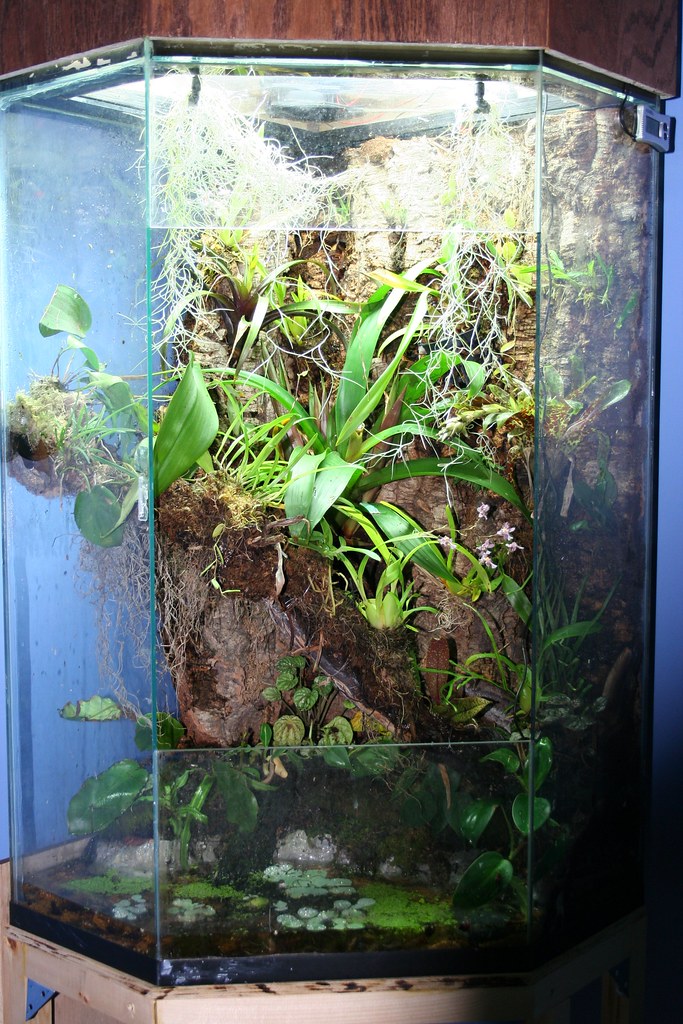
Photo by aesop via Flickr, Creative Commons
In bonsai, moss is functional before it is decorative. It reduces surface erosion during watering, moderates soil temperature, indicates moisture at a glance, and visually settles a tree into its pot. It is also actively managed rather than allowed to spread.
Bonsai growers have been managing moss on the surface of a pot for centuries, under conditions far harsher than any terrarium: shallow substrate, frequent drying, strong light and constant handling. Their solutions are practical, well tested and almost entirely unknown to terrarium builders. This guide covers what bonsai practice does with moss, which of its methods transfer indoors, and where the two crafts genuinely disagree.
Why bonsai growers use moss at all
The immediate reason is erosion. Watering a shallow pot from above displaces surface particles and exposes roots; a moss layer absorbs the impact and holds the surface intact through years of daily watering.
The second reason is diagnostic. Moss changes colour and texture as it dries far faster than soil does, so a glance at the surface gives a reading on moisture without pushing a finger into a delicate root mass.
The third is visual: moss gives the illusion of an established ground layer and hides the boundary between soil and pot rim, which is exactly the role it plays in a terrarium composition too.
The disagreement about coverage
Experienced bonsai growers frequently remove moss rather than encourage it, because a dense mat over the whole surface impedes gas exchange to the roots and makes it hard to judge when the soil is genuinely dry underneath.
The common practice is partial coverage: moss around the trunk base and at the rim, bare soil between. This is deliberately not the continuous carpet a terrarium builder aims for.
The transferable point is that moss over the top of a rooted companion plant in a terrarium can cause the same problem. Keep moss off the immediate root zone of any vascular plant sharing the vessel.
Collection and preparation methods worth stealing
Bonsai practice dries and sieves collected moss: the material is dried, crumbled and passed through a sieve to separate moss fragments from soil and debris, then sprinkled onto a damp surface where it regenerates from fragments.
This is quicker, cheaper and produces a more even result than laying whole sheets, and it works perfectly well in a terrarium. It is also the best way to establish moss in awkward corners a sheet will not sit in.
The other borrowed technique is chopping: fresh moss cut finely with scissors and scattered over damp substrate establishes within four to eight weeks. It looks like nothing for a month and then appears all at once.
Substrate lessons
Bonsai soil is famously inorganic — akadama, pumice, lava, with little or no organic content — and moss grows on it extremely well. This is direct evidence that the rich organic substrates terrarium guides recommend are not necessary for moss.
A grittier, more mineral surface layer resists compaction, stays aerobic, and discourages the fungal problems that peat-heavy mixes invite in a closed vessel. Consider top-dressing with fine grit under the moss rather than more compost.
Akadama itself is worth trying as a terrarium top layer. It holds water, stays structurally open for years, and its colour is a good neutral against most greens.
Watering and light differences
Bonsai moss lives in strong light, often several hours of direct sun, and is watered heavily every day. It is a completely different regime from a closed vessel, and it produces tight, dense, short growth rather than the loose growth typical indoors.
That density is worth noting: if your indoor moss looks loose and stretched, the difference between it and a bonsai surface is almost entirely light. More light produces tighter moss, up to the point of bleaching.
Do not import bonsai watering frequency into a sealed vessel. The daily soak works because the pot drains freely; in a closed system it is simply flooding.
Kokedama as the bridge
Kokedama — a plant's root ball bound in soil and wrapped in living moss — sits between the two crafts and is the easiest way to try bonsai-style moss management without a bonsai.
It needs a humid environment and regular soaking, and its moss layer behaves exactly like a bonsai surface: it tightens in good light and loosens in shade. It is a useful, low-cost way to learn how moss responds to handling.
Kokedama also demonstrates the moisture-indicator principle clearly. The moss visibly changes colour a day before the interior root ball is genuinely dry, which is precisely the diagnostic bonsai growers rely on.
Extended notes
- Sieved dried moss keeps for months in a paper bag and regenerates reliably. It is the closest thing to moss seed available.
- Akadama breaks down over several years and eventually compacts. In a terrarium that timeline is long enough not to matter.
- Moss on a bonsai pot rim will climb onto the glaze and stay there. Rough, unglazed pots hold it far better.
Frequently asked
Is moss good or bad for a bonsai?
Both. It protects the surface and indicates moisture, but full coverage impedes gas exchange and hides the true dryness of the soil. Partial coverage is standard practice.
Can I use bonsai soil in a terrarium?
Yes, and it works well as a top layer under moss. Inorganic substrates stay aerobic and resist compaction, which suits a closed system.
How do I grow moss from dried fragments?
Dry collected moss, crumble and sieve it, then sprinkle it onto damp substrate and keep it moist. Shoots appear in four to eight weeks.
Should moss cover the roots of plants in my terrarium?
Keep it off the immediate root zone of vascular companions. A dense mat over roots restricts gas exchange and hides the soil's true moisture state.
Source: Original guide — Mossline Workshop Desk
Related reading

How a Closed Terrarium Actually Cycles Water, Air and Nutrients
A sealed vessel is a working biogeochemical system, not a decoration that happens to be airtight. This explainer follows water through evaporation and condensation, oxygen and carbon dioxide through the daily photosynthesis and respiration cycle, and nitrogen and carbon through the decomposition pathway, then explains what limits each of them in practice and why the microbial community in the substrate does more for stability than any plant in the vessel.
Springtails and Isopods: Choosing and Managing a Cleanup Crew
A detritivore population turns a sealed jar into a functioning system, and it is the cheapest upgrade available to any build. This guide covers what springtails and dwarf isopods actually do, how to choose between the common cultures, how to seed and feed a population without fouling the substrate, what to do when numbers explode or crash, and which invertebrates are best kept out of a small planted vessel entirely.

Light Budgets: How Much Energy a Closed Vessel Actually Needs
Every closed vessel runs on a single energy input, and almost nobody measures it. This piece explains the light compensation point, why duration matters more than intensity for mosses, how photosynthesis and decomposition have to balance for a sealed system to persist, what happens to oxygen and carbon dioxide overnight, and how to work out a realistic daily light budget using nothing more sophisticated than a phone.