Moss, Humidity and the Room Around It
Dr Ruth Ansell · 2 August 2026 · 687 words · 3 min read

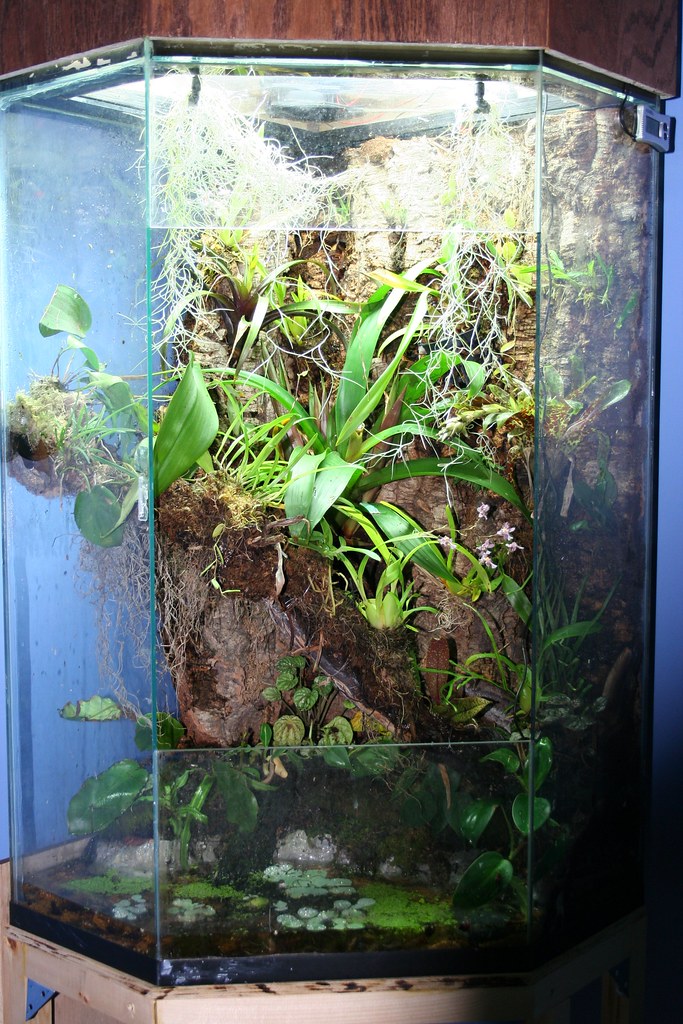
Photo by Wonderlane via Flickr, Creative Commons
Relative humidity is a ratio, not a quantity, and that single fact causes most of the confusion in this subject. Air at twenty degrees and seventy per cent holds far more water than air at ten degrees and seventy per cent, and the difference matters at every glass surface in a home.
Every planted vessel sits inside a much larger and much less stable system: your home. Room humidity, air changes, heating and even where people sit all shape what happens behind the glass, and understanding that exchange explains a great many otherwise baffling terrarium problems. This guide covers vapour pressure deficit in plain terms, how indoor humidity really behaves across a year, and what a small vessel can and cannot do to the room.
Vapour pressure deficit in plain terms
What a plant experiences is not relative humidity but vapour pressure deficit — the gap between how much water the air currently holds and how much it could hold at that temperature. VPD is what determines how fast water leaves a leaf or a moss shoot.
This is why a warm room at sixty per cent humidity dries a moss faster than a cool room at the same reading. Raising temperature without adding water widens the deficit and increases evaporative demand even though the humidity number has not moved.
For mosses, which have no cuticle worth mentioning and no stomatal control over the gametophyte, the deficit translates almost directly into water loss. They desiccate in exactly the conditions where a fern would merely look unhappy.
How indoor humidity behaves across the year
In a temperate climate, unheated indoor humidity tracks outdoor humidity fairly closely, typically fifty-five to seventy per cent. This is the autumn condition, and it is why terrariums need so little attention in September and October.
Heating changes everything. Warming cold outdoor air without adding moisture drops relative humidity dramatically — an indoor reading of twenty-five to thirty-five per cent through midwinter is entirely normal in a well-heated home, and that is desert territory for exposed moss.
Summer varies by climate but is generally intermediate, with the added complication that air conditioning also dehumidifies aggressively. An air-conditioned office in July can be as dry as a heated one in January.
The boundary layer at the glass
Inside a vessel, moss is not really exposed to the internal air average; it sits in a thin boundary layer of near-saturated air held against the cushion. This layer is why a moss in an open bowl in a dry room survives at all.
Air movement destroys the boundary layer. A fan, a draught from a door, or a heating vent strips it away continuously and forces the moss to keep replacing it, which is why a vented vessel in still air behaves completely differently from the same vessel in moving air.
The practical implication is that stillness is worth as much as humidity. Given a choice between a slightly drier still corner and a slightly more humid draughty one, take the still corner.
What a vessel does to the room
Very little, and it is worth being honest about this. A five-litre planted vessel evaporates a few millilitres a day at most into a room containing tens of thousands of litres of air. It will not measurably raise household humidity.
What it can do is create a genuine local microclimate at a distance of a few centimetres — enough that a second, smaller open dish placed immediately beside a large open build genuinely benefits. Group vessels rather than scattering them.
Claims about air purification from small plantings are similarly overstated. The honest case for a moss vessel is that it is a beautiful, low-input living object, not that it conditions your home.
Measuring rather than guessing
A cheap digital hygrometer in the room and, for larger builds, a small probe inside the vessel converts this whole subject from folklore into data. Readings inside a partial seal typically sit twenty to forty points above the room.
Log the room reading weekly for a year and you will know exactly when your problem months are, which for most temperate homes is December to February. That single record changes maintenance from reactive to planned.
Do not trust the internal readings of cheap probes to be accurate in absolute terms. They are usually consistent, though, so the trend is reliable even if the number is a few points out.
Raising humidity where it matters
The efficient interventions are all local. Tighten the closure, group vessels together, sit an open build on a wide gravel tray kept wet, or place a small cloche over a struggling patch for a few weeks.
Whole-room humidifiers work but are usually the wrong tool for one vessel: they are expensive to run, need cleaning to avoid becoming a bacterial source, and can cause condensation problems on cold walls.
Misting raises humidity for a matter of minutes, not hours. It is useful for wetting a cushion directly and close to useless as a humidity strategy, which is the single most commonly misunderstood point in indoor moss care.
Extended notes
- Cold external walls can be several degrees below room temperature, which means locally much higher humidity and, occasionally, mould behind furniture. A vessel there sees a genuinely different microclimate.
- Human occupancy adds moisture: a sleeping adult releases several hundred millilitres of water overnight, which is why bedrooms are often the most humid room in a home by morning.
- Bathrooms swing violently rather than staying humid. The average may look ideal while the range is punishing.
Frequently asked
What humidity do moss terrariums need?
Tropical species want eighty-five per cent or above, temperate cushions do best around seventy to eighty-five, and species from exposed habitat are happier at sixty to seventy with real airflow.
Does a terrarium increase room humidity?
Not meaningfully. A small vessel evaporates a few millilitres a day into a room holding thousands of litres of air. The effect is local, at centimetre scale.
Is misting an effective way to raise humidity?
Only for minutes. Misting is a way to wet the plant directly; it is not a humidity strategy. Closure and grouping do far more.
Why does my moss dry out in winter even though I water the same?
Heating widens the vapour pressure deficit, so evaporation is faster at the same watering rate. Reduce venting or increase water frequency from November.
Source: Original guide — Mossline Ecology Desk
Related reading

How a Closed Terrarium Actually Cycles Water, Air and Nutrients
A sealed vessel is a working biogeochemical system, not a decoration that happens to be airtight. This explainer follows water through evaporation and condensation, oxygen and carbon dioxide through the daily photosynthesis and respiration cycle, and nitrogen and carbon through the decomposition pathway, then explains what limits each of them in practice and why the microbial community in the substrate does more for stability than any plant in the vessel.
Springtails and Isopods: Choosing and Managing a Cleanup Crew
A detritivore population turns a sealed jar into a functioning system, and it is the cheapest upgrade available to any build. This guide covers what springtails and dwarf isopods actually do, how to choose between the common cultures, how to seed and feed a population without fouling the substrate, what to do when numbers explode or crash, and which invertebrates are best kept out of a small planted vessel entirely.

Light Budgets: How Much Energy a Closed Vessel Actually Needs
Every closed vessel runs on a single energy input, and almost nobody measures it. This piece explains the light compensation point, why duration matters more than intensity for mosses, how photosynthesis and decomposition have to balance for a sealed system to persist, what happens to oxygen and carbon dioxide overnight, and how to work out a realistic daily light budget using nothing more sophisticated than a phone.