Carpeting Species Compared: Hypnum, Taxiphyllum and Vesicularia
Dr Marit Sundqvist · 5 July 2026 · 778 words · 4 min read

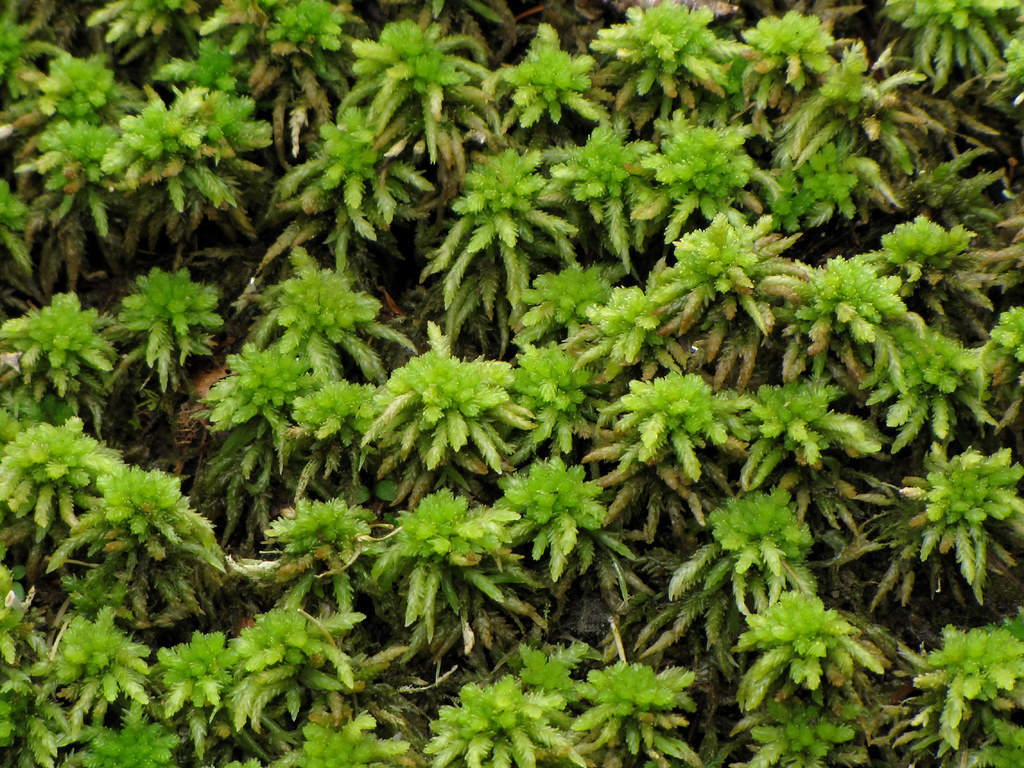
Photo via Flickr, Creative Commons
Pleurocarpous mosses branch freely along a creeping stem rather than growing as upright unbranched shoots. That habit is what makes them carpet: they spread horizontally, knit into a mat, and colonise irregular surfaces. Acrocarpous mosses such as Leucobryum grow in tufts and clumps instead. Almost every 'sheet moss' in the trade is pleurocarpous, but which one you actually receive varies enormously.
Three pleurocarpous mosses do most of the carpeting work in indoor builds, and they are constantly mislabelled at point of sale. This comparison sets sheet moss, java moss and christmas moss side by side across growth rate, temperature tolerance, texture at scale, attachment behaviour and trimming response, then gives a decision table for matching species to vessel type, and explains why buying moss by trade name alone is unreliable.
Hypnum cupressiforme — the temperate default
Sold as sheet moss, carpet moss or cypress-leaved plait moss, Hypnum is the workhorse of temperate builds. Shoots are flattened and feather-like, with leaves curving to one side, giving the mat a directional grain that catches light attractively at low angles.
It grows across a broad temperature band, thriving between twelve and twenty-two degrees and tolerating brief excursions either side. It handles lower humidity than tropical alternatives, which makes it the sensible choice for a partly open vessel or a room that dries out in winter. Growth rate is moderate: an established patch expands roughly two to four centimetres a year, faster in high humidity with strong indirect light.
Its weakness is heat. Above twenty-five degrees combined with saturation, Hypnum browns from the centre of the mat, and recovery is slow. It also accumulates a dead lower layer over time; lifting the carpet every year or two, trimming the brown base and re-laying it keeps a build looking fresh.
Taxiphyllum barbieri — java moss, the indestructible one
Java moss came into the hobby through aquariums and is now everywhere in terrarium and vivarium work. Shoots are irregular and slightly untidy, with a coarser, more tangled texture than Hypnum. It is a tropical species and prefers eighteen to twenty-eight degrees, tolerating conditions that would kill temperate moss outright.
Its defining property is adaptability. Java moss grows submerged, emersed, on soil, on wood, on rock and on mesh. It will attach to almost any porous surface within four to eight weeks if held in contact and kept humid, which makes it the standard choice for green walls and background panels.
Aesthetically it is the least refined of the three. At close viewing distance the tangle can read as messy, and it will happily overgrow a slower neighbour. Use it where mass and reliability matter more than fine texture — backgrounds, wood attachment, high-traffic vivariums — and trim it hard every couple of months to keep the surface tight.
Vesicularia dubyana and V. montagnei — the fine-textured tropicals
Christmas moss, usually sold as Vesicularia montagnei, produces distinctly triangular fronds arranged along the stem like tiny fir branches. It is the most decorative of the three and the most rewarding at close range, which suits desktop vessels viewed from thirty centimetres away.
Requirements are stricter. It wants warmth of twenty to twenty-eight degrees, consistently high humidity, and good light — under 1,000 lux it stretches, loses the characteristic branching pattern and reverts to a scruffy tangle indistinguishable from poor java moss. Many complaints that christmas moss 'turned into java moss' are simply light starvation.
Growth is slower than java moss but tidier, and the mat stays shallower, so it needs less frequent renovation. In a warm, brightly lit closed build it is the finest-textured carpet available without moving to more demanding specialists such as Fissidens or Riccardia.
Choosing between them
Match species to the vessel's real conditions rather than to the look you want. A cool room, partly open vessel, temperate hardscape: Hypnum. A warm room, sealed vessel, wood or background attachment needed: Taxiphyllum. A warm room, sealed vessel, close viewing distance and dedicated lighting: Vesicularia.
Scale is the second criterion. In a vessel under fifteen centimetres, the fine triangular fronds of christmas moss make the space read as larger. In a forty-centimetre tank, that fineness disappears at viewing distance and the stronger grain of Hypnum reads better.
Mixing is possible if the species share a temperature band, but expect a slow contest. In practice java moss wins nearly every mixed planting within a year unless you trim it deliberately. If you want a two-texture carpet, separate the species physically with hardscape or a grit margin rather than interleaving them.
Buying, quarantining and establishing
Trade names are close to meaningless. 'Sheet moss' from a florist is frequently dried and dead, sold for craft use; 'carpet moss' online may be any of half a dozen genera. Buy from suppliers who use botanical names, and if you receive live material with visible new growth at the tips, you have probably got what you paid for regardless of the label.
Quarantine everything. Rinse new moss thoroughly in room-temperature water, pick out debris and any snails or larvae by hand, and where practical hold it in a separate sealed container for two weeks before it joins an established build. That interval catches most pest problems before they reach a mature terrarium.
To establish a carpet, tear the moss into pieces the size of a thumbnail, spread them evenly across damp substrate with two to three millimetre gaps, and press each piece into firm contact. Scattered fragments knit into a continuous mat faster than a single laid sheet, because every fragment edge becomes a growing front. Keep humidity high and resist trimming for the first two months while the mat establishes.
Extended notes
- Pleurocarpous carpets naturally build up a dead brown layer beneath the living surface. This is normal and even useful as a moisture buffer, but beyond about a centimetre it holds too much water and should be trimmed.
- The buttermilk moss slurry trick works far better with pleurocarpous species than with cushion mosses, because their fragments regenerate readily from stem tissue.
- Java moss shed fragments will root anywhere they land. If you want species separation in a build, vacuum stray fragments with a pipette during maintenance rather than leaving them to establish.
Frequently asked
My carpet is browning underneath but green on top. Is that normal?
Yes, up to a point. A shallow dead layer under a living mat is expected. If the brown layer exceeds roughly a centimetre or smells sour, lift the carpet, trim it back and re-lay the living portion.
Can I use aquarium moss out of water?
Java moss and christmas moss both transition to emersed growth well, though they may look poor for two to four weeks while adapting. Keep humidity near saturation during that period and do not trim until new emersed tips appear.
How often should carpeting moss be trimmed?
Every two to four months for java moss, twice a year for Hypnum, and roughly three times a year for christmas moss. Use curved scissors and remove no more than a third of the depth at once.
Why did my new carpet stop growing entirely?
Most often poor contact with the substrate, or light below about 700 lux. Press the fragments down firmly and measure the light with a phone app before assuming a species problem.
Source: Original field guide entry — Mossline Species Desk
Related reading

Species Profile: Leucobryum glaucum, the Pale Cushion
White cushion moss is the sculptural anchor of countless terrarium builds and also one of the most frequently killed. This profile covers its structure, why the pale colour is an optical effect rather than a pigment, the drainage and airflow it demands, how to divide a cushion without destroying it, and the diagnostic difference between a cushion that is dormant and one that is rotting from the base upward.
Specialist Mosses: Sphagnum, Fissidens and the Liverwort Question
Beyond the standard carpets sit a group of species that reward specific conditions: sphagnum with its extraordinary water chemistry, Fissidens fontanus at the waterline, and the liverworts Riccardia and Marchantia — one prized, one a persistent nuisance. This piece explains what each needs, why live sphagnum behaves nothing like the dried product, and how to tell a desirable liverwort from a colonising weed before it takes over a build.

Polytrichum and Atrichum: The Upright Mosses Nobody Warns You About
Hair cap mosses are the most architecturally striking mosses available to indoor growers and the most frequently killed. Their upright stems and star-shaped rosettes look like a miniature conifer forest, but they carry internal water-conducting tissue and a set of requirements that closed vessels routinely violate. This profile covers identification, why they fail in sealed builds, and the conditions under which they genuinely thrive.