Specialist Mosses: Sphagnum, Fissidens and the Liverwort Question
Dr Marit Sundqvist · 21 June 2026 · 798 words · 4 min read
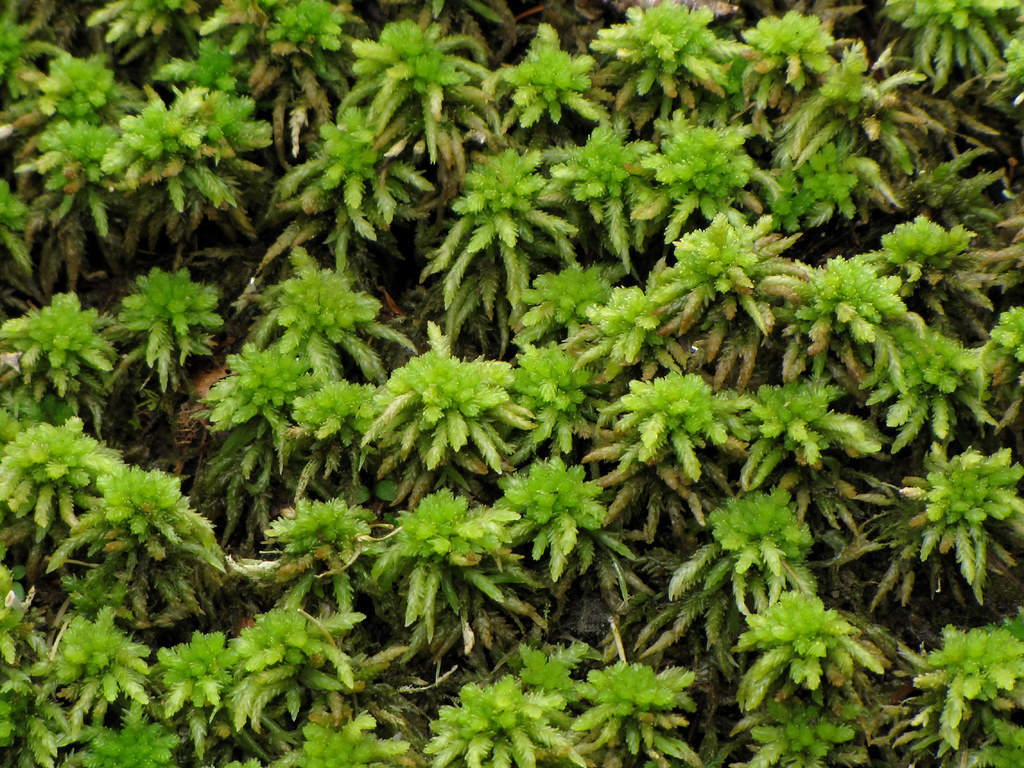
Photo via Flickr, Creative Commons
Most terrarium moss guidance covers the same four or five easy species. The specialists below are worth knowing because they solve problems the standard carpets cannot: acid buffering, waterline planting, and ultra-fine texture at millimetre scale. They also account for a disproportionate share of confused questions, because two of them are frequently sold dead and one arrives uninvited.
Beyond the standard carpets sit a group of species that reward specific conditions: sphagnum with its extraordinary water chemistry, Fissidens fontanus at the waterline, and the liverworts Riccardia and Marchantia — one prized, one a persistent nuisance. This piece explains what each needs, why live sphagnum behaves nothing like the dried product, and how to tell a desirable liverwort from a colonising weed before it takes over a build.
Live sphagnum is a different plant from the bag
The dried sphagnum sold in garden centres is a milled, sterilised horticultural product used for water retention and orchid mounting. Live sphagnum is a growing colony of dense, star-topped heads in shades from green through gold to deep crimson depending on species and light. They behave completely differently, and treating one as the other causes most sphagnum failures.
Live sphagnum actively acidifies its surroundings. It exchanges cations, releasing hydrogen ions and driving pH down toward 3.5 to 4.5 in a bog. In a terrarium that is useful for carnivorous plant companions and hostile to most standard substrate bacteria, which is why sphagnum-topped builds resist mould so well.
It also holds up to twenty times its dry weight in water in the hyaline cells of its leaves. That makes it the best available living mulch for high-moisture builds, and completely unsuitable as a top dressing over a poorly drained base, where it will keep the medium at saturation indefinitely.
Growing live sphagnum indoors
Give it the brightest light of any moss discussed here: 2,000 lux or more, and considerably more if you want the red and gold species to colour up. Under-lit sphagnum stretches into pale, weak strands and eventually collapses.
Water quality is the second requirement, and it is the one that catches people out. Sphagnum is adapted to nutrient-poor, mineral-poor rainwater. Hard tap water raises pH and delivers calcium the plant cannot tolerate, and colonies watered with it decline over a few months. Use rainwater, distilled water or reverse osmosis water exclusively.
Keep it permanently wet — sitting in one to two centimetres of standing water is fine and mirrors bog conditions — but keep the heads in air, not submerged. Temperature is flexible between ten and twenty-five degrees. Given those conditions it grows steadily and can be harvested by pinching the top three centimetres of each head, which regenerates from below.
Fissidens: the fern-moss for waterlines
Fissidens fontanus, and its more decorative relative Fissidens nobilis, have a distinctive leaf arrangement: two flattened rows along the stem with a sheathing base, so each shoot looks like a miniature fern frond. At two to four millimetres per shoot the texture is finer than anything else in common cultivation.
F. fontanus is fully aquatic-tolerant and thrives in the saturated margin of a paludarium or shoreline build, a position that kills Hypnum and rots Leucobryum. It attaches slowly to stone and wood, and its low, dense mat is ideal for suggesting a mature waterline that has been established for years.
It is slow. Expect months rather than weeks for meaningful spread, and give it stable conditions — it dislikes being moved, dried out, or subjected to sudden temperature swings. In exchange it is remarkably tidy, rarely needs trimming, and does not overrun neighbours the way java moss does.
Liverworts: Riccardia wanted, Marchantia not
Riccardia chamedryfolia, sold as coral moss or mini pellia, is not a moss at all but a thallose liverwort. It forms dense, branching, coral-like cushions of an intense bright green, and at close range nothing else in the hobby looks quite like it. It wants warmth, high humidity, clean water and good light, grows slowly, and is best used as a small accent on stone or wood rather than as a carpet.
Marchantia polymorpha is the uninvited one. It arrives on nursery plants as spores or gemmae and forms flat, lobed, liver-shaped thalli with a distinctive dark central line, spreading rapidly across damp substrate and smothering moss beneath it. It signals over-wet, over-fertilised, low-airflow conditions.
Telling them apart is easy once you know: Riccardia is fine, three-dimensional and branching like coral; Marchantia is flat, broad, leathery and lies against the surface, often with little green cups on its upper face. Remove Marchantia mechanically as soon as you see it, scraping the thallus and the top millimetre of substrate, then reduce watering and improve airflow. The gemmae cups launch propagules with every misting, so a colony left for a month becomes a season-long problem.
Fitting specialists into a normal build
Do not try to give a whole terrarium specialist conditions. Instead, build a micro-zone. A sunken pot of pure sphagnum with its own rainwater reservoir can sit inside an otherwise conventional build; a stone shelf at the waterline can host Fissidens while the bank above carries Hypnum.
Isolate water chemistry where it matters. If you are running sphagnum, mist that zone with rainwater specifically, even if the rest of the build tolerates tap water. A small labelled spray bottle is a trivial cost against losing a colony that took a year to establish.
Finally, accept different timescales. Specialists grow slowly and reveal themselves over years. A Fissidens mat at eighteen months is a genuinely different object from the same mat at three months, and the patience required is a large part of why these species remain the mark of an experienced builder rather than a beginner's first purchase.
Extended notes
- Peat harvested from bogs is sphagnum that died thousands of years ago. Using live sphagnum you grow yourself is one of the few genuinely sustainable substitutes for peat in small-scale horticulture.
- Marchantia gemmae cups eject propagules when struck by water droplets, which is why heavy misting spreads an infestation across a build within days.
- Fissidens fontanus is sometimes sold under the aquarium trade name 'Phoenix moss'. It is the same plant and transitions to emersed growth well, provided the substrate stays saturated.
Frequently asked
Can I revive dried sphagnum from a bag?
Occasionally. Long-fibre sphagnum sometimes contains viable fragments and will sprout a few green heads if kept wet under bright light for several weeks. Milled and sterilised products will not. It is a lottery, not a method.
Is Marchantia actually harmful?
It does not attack other plants chemically, but it smothers them physically and outcompetes moss for surface area. It is also an accurate diagnostic — its presence means your build is too wet with too little air movement.
Why does my Riccardia keep browning at the base?
Usually detritus settling into the cushion and rotting. Riccardia needs clean conditions and gentle water movement or airflow. Blow debris out with a pipette during maintenance and thin the cushion if it exceeds about two centimetres thick.
Do I need rainwater for ordinary terrarium mosses too?
Not usually. Hypnum, Taxiphyllum and Vesicularia tolerate moderately hard tap water, though letting it stand overnight to off-gas chlorine helps. Sphagnum and most carnivorous companions genuinely require low-mineral water.
Source: Original field guide entry — Mossline Species Desk
Related reading

Species Profile: Leucobryum glaucum, the Pale Cushion
White cushion moss is the sculptural anchor of countless terrarium builds and also one of the most frequently killed. This profile covers its structure, why the pale colour is an optical effect rather than a pigment, the drainage and airflow it demands, how to divide a cushion without destroying it, and the diagnostic difference between a cushion that is dormant and one that is rotting from the base upward.

Carpeting Species Compared: Hypnum, Taxiphyllum and Vesicularia
Three pleurocarpous mosses do most of the carpeting work in indoor builds, and they are constantly mislabelled at point of sale. This comparison sets sheet moss, java moss and christmas moss side by side across growth rate, temperature tolerance, texture at scale, attachment behaviour and trimming response, then gives a decision table for matching species to vessel type, and explains why buying moss by trade name alone is unreliable.

Polytrichum and Atrichum: The Upright Mosses Nobody Warns You About
Hair cap mosses are the most architecturally striking mosses available to indoor growers and the most frequently killed. Their upright stems and star-shaped rosettes look like a miniature conifer forest, but they carry internal water-conducting tissue and a set of requirements that closed vessels routinely violate. This profile covers identification, why they fail in sealed builds, and the conditions under which they genuinely thrive.