Choosing a Desktop Vessel: Glass, Ceramic and Wood Compared
Noor el-Amrani · 22 July 2026 · 818 words · 4 min read

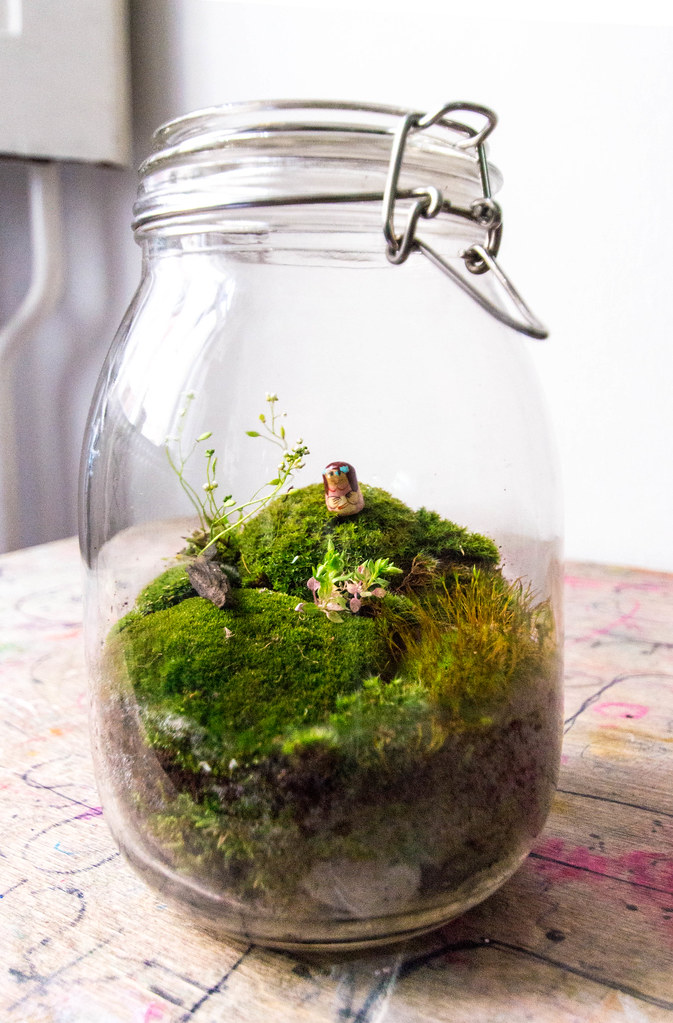
Photo via Flickr, Creative Commons
Container choice is usually made on looks and regretted on maintenance day. A vessel determines light transmission, internal air volume, thermal mass, humidity stability and — most importantly — whether your hand and tools can reach the back corner two years from now. Those are engineering questions with aesthetic consequences, not the other way round.
The container decides the microclimate, the viewing angles and how much of your build you will ever be able to reach. This comparison covers apothecary jars, cloches, geometric frames, wide bowls, cylinders and repurposed vessels, with the aperture-to-volume rule that predicts maintenance difficulty, notes on glass thickness and distortion, and the specific reasons ceramic and wood components fail in permanently humid conditions.
The aperture-to-volume rule
Before anything else, judge a vessel by the ratio of its opening to its internal volume. A wide bowl with a removable lid is trivially easy to plant and maintain. A demijohn with a four-centimetre neck and fifteen litres of volume is a genuine test of patience, requiring long tools, a funnel and considerable improvisation.
As a working guideline, if the aperture is narrower than a third of the vessel's widest internal dimension, treat it as an advanced project. You will need extension tools, you will not be able to correct mistakes easily, and any plant that outgrows its position will be difficult to remove.
Narrow apertures do buy something real: exceptional humidity stability and a sealed, self-sustaining feel. They are also the classic bottle garden aesthetic. Just choose them knowingly rather than discovering the constraint halfway through planting.
Glass: clarity, thickness and distortion
Glass is the default because it transmits light and shows the substrate layers. Not all glass is equal. Ordinary soda-lime glass has a green tint at the edges that becomes obvious in thicker sections; low-iron glass is noticeably clearer and worth the premium in a display piece.
Thickness affects thermal behaviour. A heavy-walled vessel buffers temperature swings, which is helpful on a sunny shelf, and resists cracking. Thin decorative glass heats and cools quickly, which can cause pronounced daily condensation cycles.
Curvature distorts. Spheres and strongly curved cylinders magnify whatever sits against the glass and compress the view at the edges, which is either an interesting effect or an annoyance depending on the build. Flat-panelled vessels — rectangular tanks, geometric terrariums — present the composition honestly and suit precise, architectural layouts. Geometric frames with soldered or brazed joints look superb but are rarely airtight, so treat them as open or semi-open builds and plan the planting for lower humidity.
Ceramic and stoneware components
Ceramic cannot serve as the main body of a viewing vessel, but it appears constantly as bases, trays, integrated pots and decorative elements. The key variable is glazing. A fully glazed piece is inert and waterproof and behaves like glass. Unglazed terracotta and stoneware are porous: they wick moisture, develop attractive algal and mineral patina over time, and can also wick water out of a build and onto your furniture.
That porosity is an advantage when you want it. An unglazed dish inside a build holds a moisture reservoir and grows moss on its outer surface within a season, which looks far better than a bare pot. It is a liability under a sealed vessel where it becomes a permanent damp ring on the shelf.
Check for lead and cadmium in decorative glazes if the piece is vintage or imported craft ware. In a permanently wet, mildly acidic environment, an unstable glaze can leach, and there is no good way to detect the problem before the plants show it. Modern food-safe glazed ware is a safe default.
Wood: beautiful, and the first thing to fail
Wooden bases, frames and lids are a staple of the aesthetic and the most common structural failure point. Permanently humid conditions swell timber, break glue joints, lift veneers and grow surface mould on anything untreated.
If you want wood in contact with a build, use a naturally durable species — oak, teak, cedar, black locust — finished with a hard oil or a marine-grade varnish, and never let it sit in standing water. Insert a hidden layer of cork or silicone between the wood and the glass base so condensation running down the outside does not pool in the joint.
Plywood, MDF and cheap softwood frames should be avoided entirely for anything in the humid zone. MDF in particular swells irreversibly the first time it gets properly wet. Where a build needs a wooden look but sits in a genuinely wet position, consider a stone or slate base with a thin decorative timber rim mounted clear of the moisture line.
Matching vessel to build type
For a first build, choose a wide-mouthed jar or a lidded bowl of fifteen to twenty-five centimetres. Enough volume for a real composition, an aperture you can get both hands into, and a lid that lifts for ventilation control.
For a display piece on a sideboard, a cloche over a slate or glazed base gives excellent 360-degree viewing and effortless access — you simply lift the whole cover off. The trade-off is a poorer seal and therefore lower humidity, so plan for temperate species and more frequent misting.
For a long-lived, mostly sealed ecosystem, a rectangular tank with a fitted glass lid is unglamorous and functionally superior to everything else: flat viewing panels, generous access, controllable ventilation and enough footprint for a real slope and drainage layer. For a vertical canyon or a green wall, a tall cylinder or a purpose-built vertical vivarium with a mesh panel does the job. Whatever the choice, weigh the empty vessel and imagine it full — a thirty-litre glass tank with wet substrate is a two-person lift and should be positioned before it is planted, not after.
Extended notes
- Second-hand shops are the best source of unusual vessels: sweet jars, laboratory glassware, cake domes, biscuit barrels. Check for chips at the rim, which will crack when a lid is fitted.
- Any vessel with a ground-glass or cork stopper will lose its seal over time as the cork dries and shrinks. A thin smear of food-grade silicone grease restores it.
- Avoid coloured or heavily patterned glass for planted builds. It cuts light transmission substantially and distorts the colour of the moss, which is the one thing you are trying to display.
Frequently asked
What size vessel is best for a first moss terrarium?
Fifteen to twenty-five centimetres in the widest dimension, with an opening you can fit a hand through. Smaller vessels dry out and overheat faster, and larger ones need considerably more material and planning.
Can I use a plastic container?
Functionally yes — clear polycarbonate and acrylic work fine and are used widely for propagation. They scratch easily, yellow with UV exposure over years, and never look as good as glass, so most people use them for grow-out rather than display.
Does the vessel need drainage holes?
No. A terrarium is a closed system by design; holes would drain the reservoir and defeat the water cycle. Build an internal drainage layer instead of drilling the container.
Is a lid essential?
Not essential, but it doubles the range of species you can grow and reduces maintenance dramatically. If you prefer an open build, choose species that tolerate lower humidity and expect to mist two or three times a week.
Source: Original buying guide — Mossline Workshop
Related reading
The Terrarium Toolkit: What to Buy and What to Improvise
Specialist terrarium tool kits are mostly repackaged aquarium equipment at a premium, and half the items in them are never used. This guide separates the tools that genuinely earn their place from the ones that do not, gives a tested household substitute for each, explains where cheap versions cost you in practice, and lays out a complete working kit for the price of a mediocre boxed set.

Lighting Small Planted Vessels Without Overdoing It
Moss needs less light than almost any other cultivated plant, which is precisely why lighting it badly is so easy. This guide covers the lux ranges each common species actually wants, why colour temperature matters for appearance more than for growth, how to judge whether a window position is sufficient, the heat problem with close-mounted fixtures, and how to choose and position a small LED so the build looks good as well as growing well.

Sealing, Venting and Lids That Actually Fit
The lid decides more about a planted vessel than the glass beneath it. It sets humidity, gas exchange, temperature swing and how often you will need to intervene, and most builds fail because the closure was chosen last rather than first. This guide covers full seals, partial seals and deliberate venting, how to test a closure before planting, and how to retrofit ventilation to a vessel that came with none.