Lighting Small Planted Vessels Without Overdoing It
Noor el-Amrani · 24 June 2026 · 763 words · 3 min read

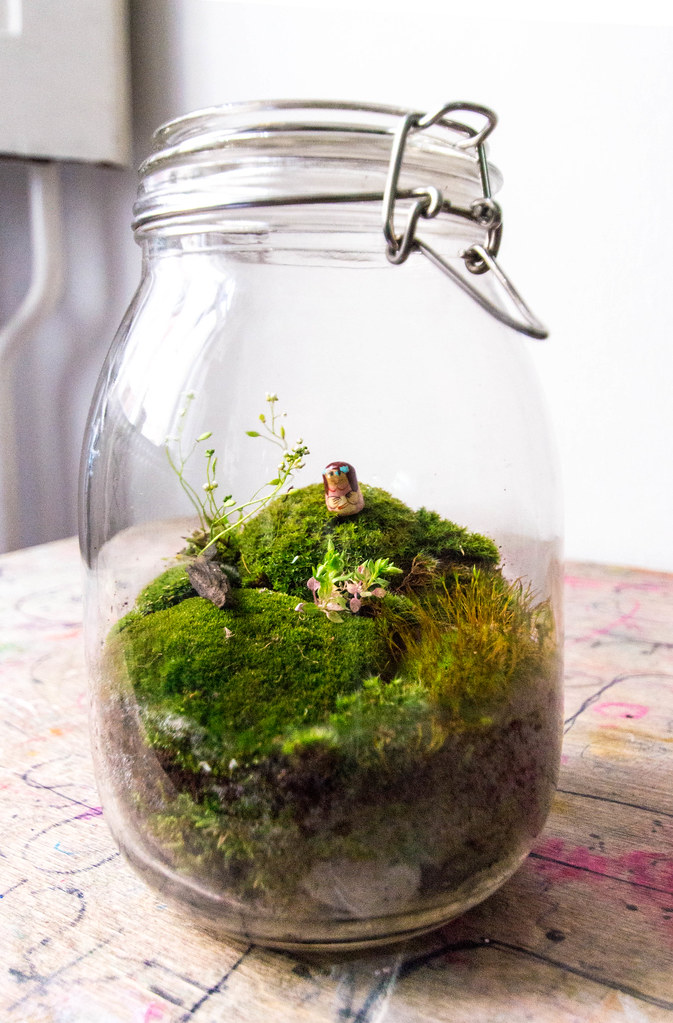
Photo via Flickr, Creative Commons
Mosses evolved in the understorey, on shaded rock and on the north side of trunks. Their light compensation point — the intensity at which photosynthesis balances respiration — is very low, and their saturation point is reached far below full daylight. Practically, that means the useful working range is narrow and easy to overshoot.
Moss needs less light than almost any other cultivated plant, which is precisely why lighting it badly is so easy. This guide covers the lux ranges each common species actually wants, why colour temperature matters for appearance more than for growth, how to judge whether a window position is sufficient, the heat problem with close-mounted fixtures, and how to choose and position a small LED so the build looks good as well as growing well.
The numbers that matter
Measured at the moss surface, most terrarium species do well between 800 and 2,000 lux for ten to twelve hours a day. Below roughly 500 lux, shoots stretch, colour pales and carpets thin. Above about 5,000 lux in an enclosed vessel you risk bleaching, and direct sun through glass — which can exceed 50,000 lux — scorches foliage within hours.
Species vary within that band. Hypnum and Leucobryum are content at the lower end, 800 to 1,500 lux. Vesicularia wants the upper end, 1,500 to 2,500, and loses its characteristic branching structure below that. Live sphagnum wants more still, 2,500 lux and up, and colours red only under genuinely bright conditions.
Measure rather than guess. A free phone lux meter is accurate enough, and the readings are frequently surprising: a spot that feels bright to the eye a metre inside a north-facing room often measures under 300 lux, because human vision adapts logarithmically while plants respond to actual photon flux.
Window positions, honestly assessed
North-facing windows, in the northern hemisphere, are close to ideal for moss: steady indirect light, no direct beam, minimal heat. A vessel within a metre of a north window usually needs no supplement in summer and a small one in winter.
East-facing gives gentle morning sun, which most species tolerate for an hour or two. West-facing gives harsher afternoon sun and heat, and a closed vessel there will cook. South-facing is unsuitable for a directly placed build; set it two or three metres back, or behind a sheer curtain, and measure.
The overriding rule is that heat is the limiting factor, not light. A vessel receiving direct sun accumulates heat far faster than an open pot because the glass traps infrared. Many builds killed by 'too much light' were actually killed by an internal temperature of thirty-five degrees on a bright afternoon in April.
Choosing an artificial fixture
A small full-spectrum LED at 6,000 to 6,500 kelvin is the correct default. That colour temperature renders green foliage accurately and reads as clean daylight, which matters because you are looking at this thing every day. Warm 2,700-kelvin household bulbs make moss look yellow-brown and dull.
Avoid purple 'blurple' grow lights entirely. They are efficient for crop production and make a moss landscape look like laboratory equipment. Any full-spectrum white LED provides more than enough usable photons for a plant with moss's modest requirements.
Power is rarely the constraint. A three to eight watt LED at fifteen to twenty-five centimetres above a desktop vessel typically lands in the right range. Clip lamps, small gooseneck fixtures and slim LED bars all work. Put it on a mechanical or smart timer — consistency of photoperiod matters more than precision of intensity, and no one maintains a manual schedule for a year.
Positioning, heat and the look of the light
Mount the fixture above and slightly forward of the vessel, angled back. Light from directly overhead flattens the composition; light from slightly in front and above casts the small shadows behind hardscape that give a miniature landscape its depth. This is a photographic consideration and it makes a large visible difference.
Check heat by holding the back of your hand at the top of the vessel after the light has run two hours. If it feels distinctly warm, raise the fixture. LEDs are efficient but not cool, and a close-mounted fixture on a sealed vessel can add three to five degrees internally.
Watch for a single-sided growth response. Moss grows toward light, and a fixture placed to one side will produce a visibly lopsided carpet within a couple of months. Either centre the light or rotate the vessel a quarter turn weekly. The rotation habit also gives you a regular excuse to inspect all four sides of the build, which is how most problems get caught early.
Photoperiod, algae and restraint
Ten to twelve hours is the standard. Longer photoperiods do not accelerate moss growth appreciably, because the plant saturates at low intensity, but they do reliably accelerate algae on the glass and in any standing water.
If green film appears on the inside of the glass, cut the photoperiod to eight hours for a fortnight before changing anything else. Algae responds to light duration much more sharply than moss does, so this is a low-risk diagnostic that usually resolves the problem outright.
The general principle in this hobby is that less light, applied consistently, beats more light applied enthusiastically. A build under a modest LED on a timer for twelve months will outperform one that was moved to the sunny sill because it 'looked like it needed more'. Moss is a shade plant. Treat generosity with light as the risk it actually is.
Extended notes
- Colour rendering index matters for appearance. A fixture with CRI above 90 makes the subtle range of greens in a mixed moss planting visible; a cheap CRI 70 LED flattens them all to one shade.
- If the vessel sits in a room used in the evening, run the photoperiod to end at bedtime rather than in mid-afternoon. You will enjoy the build far more, and the plants are indifferent to the schedule as long as it is consistent.
- Light passing through condensation is diffused and reduced by roughly ten to twenty percent. A permanently fogged vessel is also a permanently dimmed one, which is a rarely mentioned reason to keep the humidity balance right.
Frequently asked
Can moss survive with no natural light at all?
Yes. A windowless room with a suitable LED on a timer works perfectly well, and gives you more control than most window positions. Interior offices are among the better places to keep a moss build.
How do I know if my moss is getting too little light?
Look for stretched, leggy shoots with increased spacing between leaves, a pale washed-out green, and a carpet that thins rather than densifies. Measure at the surface; anything under about 500 lux is the likely cause.
Do I need a UV component?
Not for plants. Moss and terrarium ferns have no UV requirement. UVB matters only if the enclosure houses reptiles, which is a different discipline with different plant considerations.
Is a full-spectrum LED necessary, or will a desk lamp do?
A bright white LED desk lamp at the right distance and photoperiod will grow moss perfectly well. The main compromise is colour rendering — the build will simply not look as good as it does under a high-CRI daylight source.
Source: Original buying guide — Mossline Workshop
Related reading
The Terrarium Toolkit: What to Buy and What to Improvise
Specialist terrarium tool kits are mostly repackaged aquarium equipment at a premium, and half the items in them are never used. This guide separates the tools that genuinely earn their place from the ones that do not, gives a tested household substitute for each, explains where cheap versions cost you in practice, and lays out a complete working kit for the price of a mediocre boxed set.

Sealing, Venting and Lids That Actually Fit
The lid decides more about a planted vessel than the glass beneath it. It sets humidity, gas exchange, temperature swing and how often you will need to intervene, and most builds fail because the closure was chosen last rather than first. This guide covers full seals, partial seals and deliberate venting, how to test a closure before planting, and how to retrofit ventilation to a vessel that came with none.

Choosing a Desktop Vessel: Glass, Ceramic and Wood Compared
The container decides the microclimate, the viewing angles and how much of your build you will ever be able to reach. This comparison covers apothecary jars, cloches, geometric frames, wide bowls, cylinders and repurposed vessels, with the aperture-to-volume rule that predicts maintenance difficulty, notes on glass thickness and distortion, and the specific reasons ceramic and wood components fail in permanently humid conditions.