The Terrarium Toolkit: What to Buy and What to Improvise
Noor el-Amrani · 8 July 2026 · 705 words · 3 min read
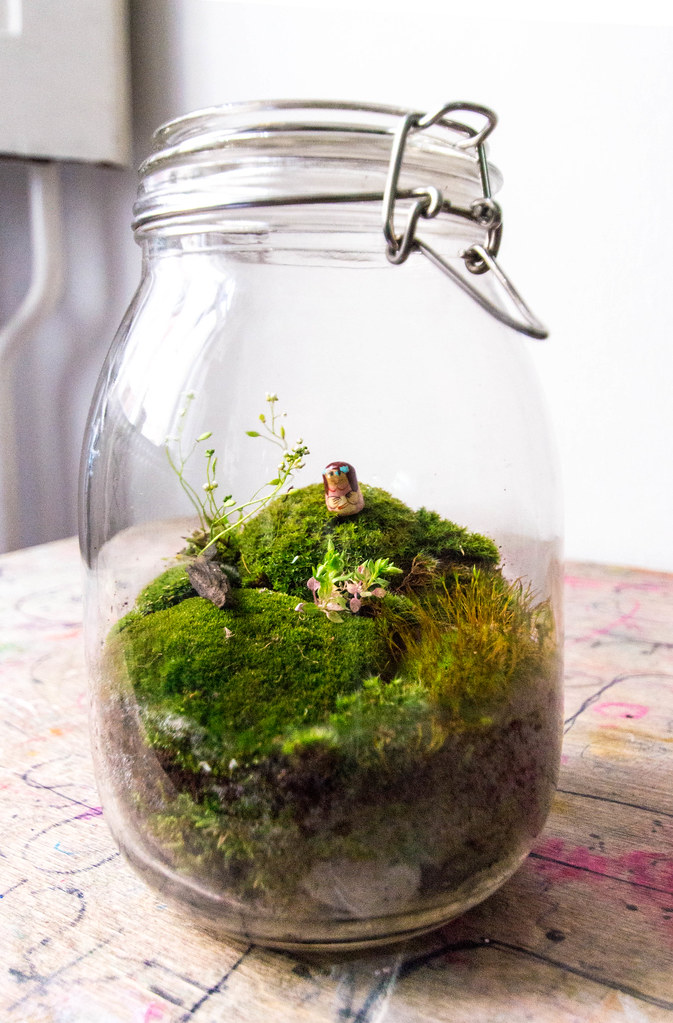
Photo via Flickr, Creative Commons
Almost every task in a planted vessel is a variation on reaching, placing, compacting, cutting and cleaning at arm's length through a restricted opening. The tools that matter are the ones that extend your reach without obscuring your view, and there are perhaps six of them.
Specialist terrarium tool kits are mostly repackaged aquarium equipment at a premium, and half the items in them are never used. This guide separates the tools that genuinely earn their place from the ones that do not, gives a tested household substitute for each, explains where cheap versions cost you in practice, and lays out a complete working kit for the price of a mediocre boxed set.
The tools that genuinely earn their place
Long tweezers, thirty centimetres, straight or slightly curved. This is the single most useful item; everything else is optional by comparison. Buy stainless steel with a fine tip and a comfortable spring — the cheap ones misalign at the tip within a few uses, which makes placing a moss fragment impossible.
Curved scissors, twenty to twenty-five centimetres. Curvature matters more than length, because it lets you cut parallel to a surface without your hand blocking the view. Aquascaping scissors are the correct tool and are widely available at reasonable prices.
A tamper or flat-ended rod for compacting substrate and pressing moss into contact. A long spoon works; a purpose-made flat disc on a shaft works better. Given how much of a build's survival depends on firm rhizoid contact, this unglamorous item deserves its place.
A spray bottle with a fine, adjustable mist. A coarse jet displaces substrate and knocks fragments loose. Buy one good bottle rather than three bad ones; the pump mechanism is what fails.
Useful, but improvisable
A funnel for substrate delivery into narrow-necked vessels. A rolled sheet of stiff paper does the same job and can be shaped to fit an awkward neck, which a rigid plastic funnel cannot.
A pipette or turkey baster for spot-watering and for extracting standing water. A length of five-millimetre aquarium tubing is cheaper, works as a siphon for larger volumes, and doubles as a debris blower.
A soft brush for cleaning the inside of the glass and for dusting foliage. A clean makeup brush taped to a bamboo skewer is a well-known substitute and is genuinely better than most branded versions because you can angle it.
A magnifier for inspection. Your phone camera at maximum zoom is sufficient for identifying pests and checking new growth, and it records what you saw for comparison later.
Tools that are usually a waste of money
Miniature rakes. They appear in every boxed set, look charming, and do essentially nothing that a chopstick will not. Raking patterns in substrate is a zen-garden idea that does not transfer to a moss build where the surface is planted.
Miniature shovels. Too small to move meaningful material and too clumsy for precision. A dessert spoon and a folded card do both jobs better.
Angled spatulas sold for 'levelling'. In practice you level with a tamper and the back of a spoon.
Very cheap complete kits. The tweezers misalign, the scissors do not close cleanly, and the spray bottle fails in a month. Two good tools outperform a nine-piece set consistently, and cost less over two years.
Consumables worth stocking
Lightweight expanded clay aggregate for drainage, horticultural charcoal at roughly ten percent of the medium, sieved coir, fine orchid bark and a bag of pumice or perlite. Together these cover every substrate recipe in this hobby, and bought in bulk they cost a fraction of pre-mixed terrarium soil.
Fine mesh or horticultural fleece for the barrier layer between drainage and medium. A cut-up net laundry bag works perfectly and costs almost nothing.
Distilled or filtered water if your tap water is hard. A five-litre container lasts months at misting volumes and eliminates both mineral spotting on the glass and the slow pH drift that stalls moss growth.
A culture of springtails, and optionally dwarf white isopods. These are consumables in the sense that you establish them once and they sustain themselves, and they do more for build health than any tool on this list.
A complete working kit
Thirty-centimetre stainless tweezers, curved aquascaping scissors, a flat tamper, one good adjustable mist bottle, a metre of aquarium tubing, a soft brush on a skewer, and a paper funnel you make when needed. That is the whole kit, and it will handle everything from a ten-centimetre jar to a sixty-litre vivarium.
Add, only if you find yourself needing them: a long-handled spoon for deep vessels, a pair of angled tweezers for reaching behind hardscape, and a small LED torch for inspecting the drainage reservoir.
Look after the metal. Rinse and dry tweezers and scissors after every session; permanently humid work plus organic residue will pit cheap stainless within a year. A tool roll or a jar on the shelf keeps tips from bending, which is the other way good tweezers die. Well-kept, this kit outlasts most of the builds you will make with it.
Extended notes
- Chopsticks are the most underrated terrarium tool. Bamboo, disposable, free with takeaway, perfect for positioning moss, propping hardscape and clearing debris — and they cause less bruising to foliage than metal.
- If you build regularly, a cheap turntable or lazy Susan under the vessel transforms the experience. Rotating the build rather than reaching around it eliminates most awkward angles.
- Sieving substrate through a kitchen colander before use removes the fines that eventually silt up a drainage reservoir. It takes five minutes and adds years to the build.
Frequently asked
Do I really need thirty-centimetre tweezers for a small jar?
For a jar under fifteen centimetres you can manage with fingers and chopsticks. Long tweezers become essential the moment the opening is narrower than your hand or the vessel is deeper than your wrist.
What can I use instead of aquascaping scissors?
Small embroidery or nail scissors for shallow work. The limitation is reach, not sharpness — anything beyond about fifteen centimetres of depth genuinely needs the long curved pair.
How do I clean the inside of the glass without disturbing the build?
A soft brush or a clean cloth wrapped around a chopstick, working top to bottom, then a pipette to remove any debris that falls. Never use glass cleaner or detergent anywhere near a planted vessel.
Is pre-mixed terrarium substrate worth buying?
For a first build it is a reasonable convenience. Beyond that, mixing your own from coir, bark, pumice and charcoal costs far less, and lets you adjust drainage to the specific vessel and species.
Source: Original buying guide — Mossline Workshop
Related reading

Lighting Small Planted Vessels Without Overdoing It
Moss needs less light than almost any other cultivated plant, which is precisely why lighting it badly is so easy. This guide covers the lux ranges each common species actually wants, why colour temperature matters for appearance more than for growth, how to judge whether a window position is sufficient, the heat problem with close-mounted fixtures, and how to choose and position a small LED so the build looks good as well as growing well.

Choosing a Desktop Vessel: Glass, Ceramic and Wood Compared
The container decides the microclimate, the viewing angles and how much of your build you will ever be able to reach. This comparison covers apothecary jars, cloches, geometric frames, wide bowls, cylinders and repurposed vessels, with the aperture-to-volume rule that predicts maintenance difficulty, notes on glass thickness and distortion, and the specific reasons ceramic and wood components fail in permanently humid conditions.

Sealing, Venting and Lids That Actually Fit
The lid decides more about a planted vessel than the glass beneath it. It sets humidity, gas exchange, temperature swing and how often you will need to intervene, and most builds fail because the closure was chosen last rather than first. This guide covers full seals, partial seals and deliberate venting, how to test a closure before planting, and how to retrofit ventilation to a vessel that came with none.