How a Closed Terrarium Actually Cycles Water, Air and Nutrients
Dr Marit Sundqvist · 20 July 2026 · 833 words · 4 min read

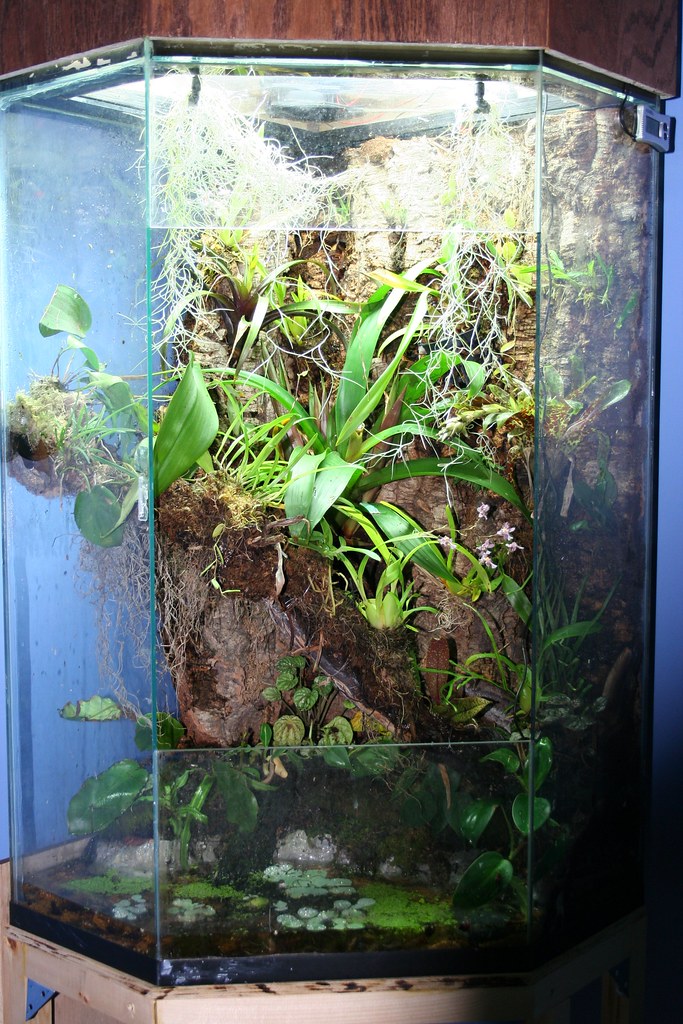
Photo via Flickr, Creative Commons
Ecologists call a system closed when it exchanges energy but not matter with its surroundings. A sealed terrarium approximates that: light enters and heat leaves, but water, carbon and nutrients are conserved inside. Everything that goes wrong in a closed build is a failure of one of the three cycles below, so understanding them turns troubleshooting from guesswork into diagnosis.
A sealed vessel is a working biogeochemical system, not a decoration that happens to be airtight. This explainer follows water through evaporation and condensation, oxygen and carbon dioxide through the daily photosynthesis and respiration cycle, and nitrogen and carbon through the decomposition pathway, then explains what limits each of them in practice and why the microbial community in the substrate does more for stability than any plant in the vessel.
The water cycle, and why it is self-regulating
Water evaporates from the substrate and transpires from foliage, saturating the internal air. When that air contacts the glass — cooler than the interior because the room is cooler still — it reaches its dew point and condenses. The droplets run down the walls and return to the substrate. This is a complete hydrological cycle operating over a few hours in a space you can pick up.
It is self-regulating within limits. If the substrate dries slightly, evaporation slows and condensation slows with it, conserving water. If the substrate is over-wet, evaporation runs faster and more water is held in the air and on the glass at any moment, which is exactly why permanent heavy fogging indicates excess.
What breaks the cycle is a temperature gradient the system cannot handle. Direct sun raises the interior above the room temperature dramatically, condensation stops forming because the glass is no longer the coolest surface, and humidity accumulates without returning. Position, not water volume, is the usual culprit when a well-built vessel misbehaves.
Gas exchange over twenty-four hours
During the light period, photosynthesis consumes carbon dioxide and releases oxygen. At night, respiration by plants, microbes and detritivores reverses that, consuming oxygen and releasing carbon dioxide. The vessel breathes on a daily rhythm.
Neither gas accumulates over the long run, because the two processes are coupled through the same carbon pool. Carbon fixed into plant tissue during the day is eventually returned by decomposition, at which point the oxygen used to build it is consumed again. That coupling is why sealed systems persist for decades rather than suffocating or over-oxygenating.
It can be locally overwhelmed. A large mass of fresh organic matter — a dead plant, a chunk of unweathered wood, a heavy overdose of leaf litter — creates a decomposition spike that consumes oxygen faster than photosynthesis replaces it, particularly in saturated substrate where diffusion is slow. The result is an anaerobic pocket, a sour smell and black rot. The fix is always the same: remove the excess material and restore drainage so oxygen can reach the substrate.
Nutrients: the decomposition pathway
There is no fertiliser in a closed system and there should not be. Nutrients cycle: plants take up nitrogen, phosphorus and potassium; those elements are locked in tissue; the tissue eventually dies; microbes and detritivores break it down; and the mineralised nutrients return to the substrate for re-uptake.
The rate-limiting step is decomposition, which depends on the microbial community and the invertebrates that shred material to give microbes more surface area to work on. This is why springtails and isopods matter so much more than their size suggests — they are the mechanical stage of the nutrient cycle.
It also explains a common observation: builds made with sterilised substrate and no microfauna often look excellent for six months and then stall. Growth slows, colour dulls, and nothing appears to be wrong. What has happened is that the readily available nutrients were used up and the return pathway was never established. Adding a springtail culture and a handful of leaf litter usually restarts the system within a couple of months.
The microbial layer nobody sees
The substrate of a healthy build hosts an enormous bacterial and fungal community. Mycorrhizal and saprophytic fungi break down cellulose and lignin, nitrifying bacteria convert ammonia to nitrite and then nitrate, and a range of organisms compete with and suppress opportunistic pathogens.
That competitive suppression is the real reason established builds resist mould while new ones bloom with it. A new vessel is an unoccupied habitat with abundant free sugars; the first organisms to arrive expand explosively. Once a diverse community is in place, resources are contested and no single species dominates.
The practical implication is counterintuitive: do not sterilise everything. Baking wood to kill pest eggs is sensible, but pasteurising the entire substrate removes the community that would otherwise stabilise the build. A reasonable middle path is clean, unsterilised medium, thoroughly prepared hardscape, and a deliberate inoculation of springtails plus a scoop of substrate from a healthy existing build.
Where the analogy to a real ecosystem breaks down
A terrarium is far too small for genuine ecological redundancy. A natural forest floor has hundreds of decomposer species; your jar has perhaps a handful. Lose one and there is nothing to fill the gap, which is why closed builds are stable in some respects and fragile in others.
Energy input is also entirely under your control, and it is the one thing the system cannot regulate. Too little light and the whole thing slowly runs down as respiration exceeds photosynthesis. Too much and heat destroys the water cycle. Everything else self-corrects to a degree; light does not.
Finally, a terrarium has no immigration. In nature, a local extinction is repaired by dispersal from elsewhere. In a sealed vessel, extinction is permanent unless you open the lid. That is the strongest argument for building a diverse community deliberately at the outset: several moss species rather than one, litter as well as living plants, and a detritivore population established early, so that the system has some slack when — not if — one component fails.
Extended notes
- The daily oxygen swing in a small sealed vessel can be surprisingly large, but it does not harm the plants; they are adapted to the same fluctuation in dense vegetation at night.
- Charcoal in the substrate provides enormous surface area for microbial colonisation. Its value is as habitat far more than as a filter.
- A closed build that has been running for a year has measurably different substrate chemistry from the day it was made — generally more acidic, with a higher organic fraction. This is normal maturation and usually favours moss.
Frequently asked
Do I need to add oxygen to a sealed terrarium?
No. Photosynthesis produces it internally, and the system balances across the daily cycle. Opening a vessel to 'let it breathe' is unnecessary for gas reasons, though occasional ventilation helps with humidity control.
Should I ever fertilise a closed build?
Almost never. Nutrients cycle internally, moss cannot regulate uptake, and added fertiliser reliably produces algae. If growth has genuinely stalled, add leaf litter and detritivores rather than feed.
Why does a new terrarium go mouldy and an old one does not?
Free sugars plus an empty niche. New wood and fresh substrate offer abundant easy food with no established competitors. Once a diverse microbial and springtail community occupies the space, blooms stop happening.
How small can a genuinely self-sustaining system be?
Working closed builds exist below half a litre, but stability increases sharply with volume. Below about two litres, temperature and humidity swings are fast enough that small mistakes become fatal quickly.
Source: Original explainer — Mossline Ecology Desk
Related reading
Springtails and Isopods: Choosing and Managing a Cleanup Crew
A detritivore population turns a sealed jar into a functioning system, and it is the cheapest upgrade available to any build. This guide covers what springtails and dwarf isopods actually do, how to choose between the common cultures, how to seed and feed a population without fouling the substrate, what to do when numbers explode or crash, and which invertebrates are best kept out of a small planted vessel entirely.

Light Budgets: How Much Energy a Closed Vessel Actually Needs
Every closed vessel runs on a single energy input, and almost nobody measures it. This piece explains the light compensation point, why duration matters more than intensity for mosses, how photosynthesis and decomposition have to balance for a sealed system to persist, what happens to oxygen and carbon dioxide overnight, and how to work out a realistic daily light budget using nothing more sophisticated than a phone.

Companion Planting: What Grows Well Alongside Moss Indoors
Moss sets the conditions and everything else has to live within them: high humidity, low light, cool to moderate warmth and a substrate that must never be fertilised. This guide covers the small ferns, creeping vines, miniature epiphytes and the handful of flowering plants that genuinely thrive in those conditions, the popular species that are sold for terrariums and should not be, and how to plan a planting so one species does not erase the rest.