Companion Planting: What Grows Well Alongside Moss Indoors
Dr Marit Sundqvist · 26 June 2026 · 787 words · 4 min read

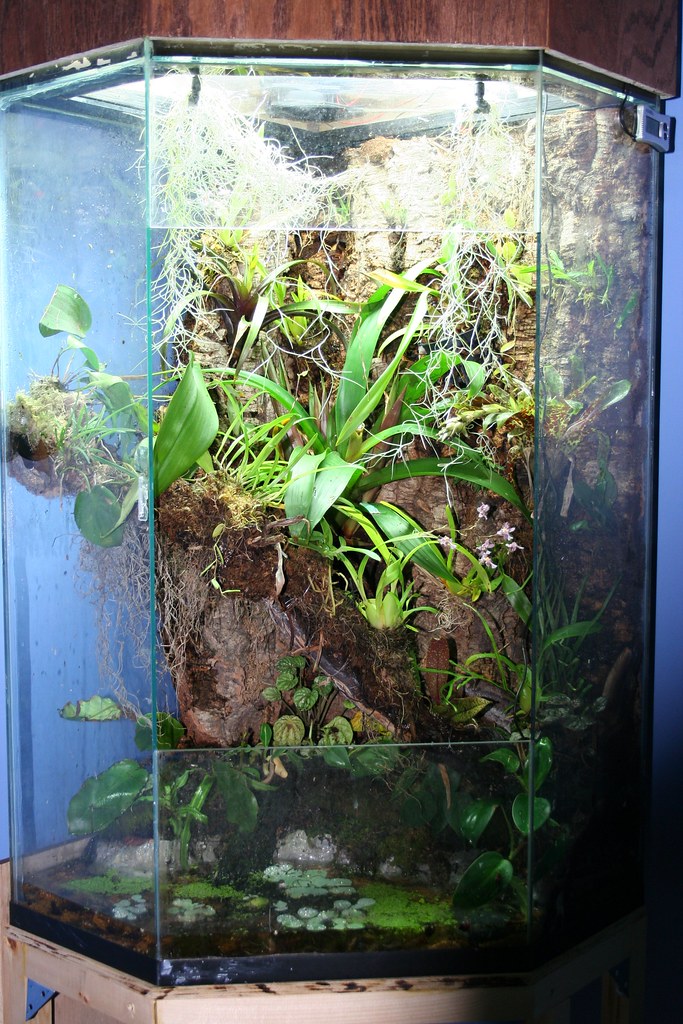
Photo via Flickr, Creative Commons
The constraint stack in a moss build is unusual. Most houseplants want a drying cycle between waterings, moderate humidity and periodic feeding. Moss requires the opposite of all three. Companion species therefore come from a narrow ecological band — understorey plants of humid forests, epiphytes and rheophytes — rather than from the general houseplant range.
Moss sets the conditions and everything else has to live within them: high humidity, low light, cool to moderate warmth and a substrate that must never be fertilised. This guide covers the small ferns, creeping vines, miniature epiphytes and the handful of flowering plants that genuinely thrive in those conditions, the popular species that are sold for terrariums and should not be, and how to plan a planting so one species does not erase the rest.
Ferns: the natural partners
Small ferns share moss's habitat requirements almost exactly, which is why the pairing looks right as well as growing well. The best terrarium candidates are the genuinely small ones: Asplenium species such as the dwarf bird's nest cultivars, Pteris cretica in its compact forms, Adiantum raddianum for delicate texture, and Nephrolepis 'Duffii' for a tight upright habit.
Davallia and Humata, the rabbit's-foot and hare's-foot ferns, deserve particular mention. Their furry surface rhizomes creep across wood and stone rather than rooting deep, which makes them ideal for shallow builds and for growing over hardscape. They also tolerate slightly drier conditions than most terrarium ferns.
Scale is the constraint. Avoid anything that reaches thirty centimetres, and be sceptical of nursery labels — a fern sold small in a nine-centimetre pot may be a species that eventually reaches a metre. Look up the mature size before planting, because removing an established fern from a narrow-necked vessel is genuinely difficult.
Creeping and trailing species
Ficus pumila 'Quercifolia' is the standard climbing choice: tiny oak-shaped leaves, a self-clinging habit, and a willingness to cover wood and background panels. It is vigorous and needs pruning three or four times a year, but it is easily controlled with scissors and it responds well to hard cutting back.
Pilea depressa and Pilea glauca provide a soft, spilling texture and root readily from cuttings, which makes them useful for filling awkward gaps. Soleirolia soleirolii — baby's tears — has the finest texture of the group and the worst manners: in a humid closed build it will carpet everything within a season and smother slower moss. Use it only where you intend it to dominate.
Peperomia prostrata and Peperomia rotundifolia are slower, more succulent and better behaved, trailing over stone at a pace that lets moss keep up. Callisia repens does the same job with a slightly coarser leaf. In every case, the deciding factor should be growth rate relative to your trimming habits rather than appearance in the nursery pot.
Epiphytes and specialty accents
Miniature bromeliads in the Neoregelia and Cryptanthus genera grow well in high humidity and provide the one thing moss builds usually lack, which is strong colour. They need better light than moss and are best mounted high on wood or a background rather than planted into substrate, where their bases rot.
Miniature orchids — Lepanthes, Pleurothallis, small Masdevallia — are the advanced option. They demand consistent cool humidity, good air movement and clean water, and they are unforgiving of neglect. In a well-run vivarium they are spectacular; in a first terrarium they are an expensive way to learn.
Selaginella, the spikemosses, deserve a note of caution despite being sold everywhere for terrariums. They are beautiful and genuinely suited to high humidity, but they are also intolerant of drying for even a day and prone to crown rot in saturated positions. Plant them on a raised, well-drained spot with reliable moisture and they thrive; plant them in a wet hollow and they collapse within weeks.
Popular choices that do not belong
Succulents and cacti are sold in terrarium kits constantly and are entirely unsuitable for a closed humid vessel. They need a drying cycle, low humidity and bright light, and they rot within months in moss conditions. Open shallow bowls with grit substrate are their format, and moss should not be in them.
Full-size tropical foliage — Monstera, Philodendron, Calathea, Alocasia — outgrows any desktop vessel within a year. Calathea in particular is offered as a terrarium plant because it likes humidity, and it is simply too large.
Anything requiring regular feeding is a poor fit, because fertiliser scorches moss and fuels algae. That excludes most flowering houseplants. Also avoid Fittonia if you want a stable composition rather than a stable ecosystem: it thrives, but it is vigorous, dramatically wilt-prone as a signal plant, and will take over a small vessel's floor within two years.
Planning a planting that stays balanced
Choose one dominant textural theme and support it. A build with a fern, a trailing vine, a bromeliad and three mosses is a plant collection; a build with one fern and two mosses is a landscape. Restraint at planting is what makes a composition legible at year two.
Match growth rates deliberately. Pair a vigorous coloniser with a vigorous moss, or a slow fern with a slow cushion. Mixing a fast vine with a slow moss guarantees an annual battle you will eventually lose or grow tired of fighting.
Finally, position by moisture rather than by aesthetics. Every build has a wet zone and a dry ridge, and matching each species to the right one solves most companion-planting problems before they start. A Selaginella on the ridge and a Fissidens at the waterline will both flourish; swap them and both will fail, regardless of how much attention you give the vessel afterwards.
Extended notes
- Nursery plants routinely arrive with systemic pesticide residues that are harmful to springtails and isopods. Rinse the root ball thoroughly and quarantine for two weeks before adding to a build with an established cleanup crew.
- Terrarium plants sold in tissue-culture cups are pest-free and adapt readily to high humidity, which makes them a genuinely superior source for closed builds despite their small size.
- A wilting Fittonia recovers within an hour of watering and is often used deliberately as a moisture indicator in larger vivariums.
Frequently asked
Can I keep a carnivorous plant with moss?
Yes, in a dedicated build. Sundews and small pitcher plants pair naturally with live sphagnum, but they require bright light and low-mineral water, so plan the whole vessel around them rather than adding one to an existing moss build.
Why did my fern die while the moss thrived?
Usually light or drainage. Ferns need more light than moss and, unlike moss, have true roots that rot in saturated substrate. Give the fern a raised, better-drained position with the best light in the vessel.
How many plants should a twenty-centimetre terrarium hold?
One or two vascular plants plus the moss carpet. More than that and the composition closes up within a year and maintenance becomes constant.
Do companion plants need fertiliser?
In a closed system with litter and detritivores, no. If a vascular plant is clearly nutrient-starved, place a small slow-release pellet directly at its roots rather than treating the whole vessel — and keep it well away from the moss.
Source: Original explainer — Mossline Ecology Desk
Related reading

How a Closed Terrarium Actually Cycles Water, Air and Nutrients
A sealed vessel is a working biogeochemical system, not a decoration that happens to be airtight. This explainer follows water through evaporation and condensation, oxygen and carbon dioxide through the daily photosynthesis and respiration cycle, and nitrogen and carbon through the decomposition pathway, then explains what limits each of them in practice and why the microbial community in the substrate does more for stability than any plant in the vessel.
Springtails and Isopods: Choosing and Managing a Cleanup Crew
A detritivore population turns a sealed jar into a functioning system, and it is the cheapest upgrade available to any build. This guide covers what springtails and dwarf isopods actually do, how to choose between the common cultures, how to seed and feed a population without fouling the substrate, what to do when numbers explode or crash, and which invertebrates are best kept out of a small planted vessel entirely.

Light Budgets: How Much Energy a Closed Vessel Actually Needs
Every closed vessel runs on a single energy input, and almost nobody measures it. This piece explains the light compensation point, why duration matters more than intensity for mosses, how photosynthesis and decomposition have to balance for a sealed system to persist, what happens to oxygen and carbon dioxide overnight, and how to work out a realistic daily light budget using nothing more sophisticated than a phone.