Light Budgets: How Much Energy a Closed Vessel Actually Needs
Dr Halvard Sten · 18 July 2026 · 611 words · 3 min read

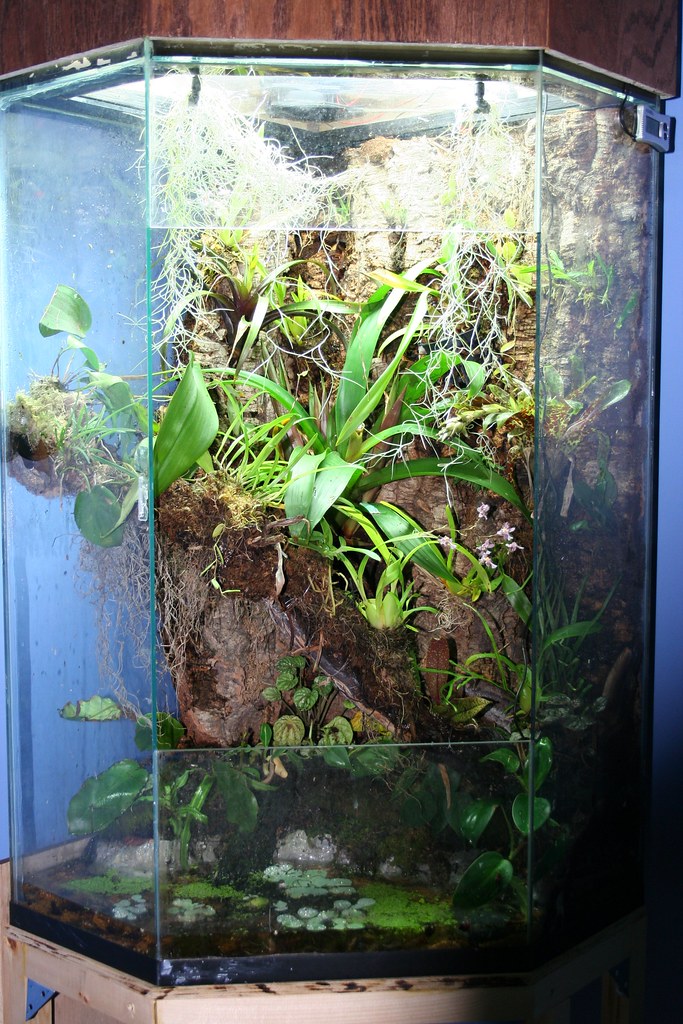
Photo by HorsePunchKid via Flickr, Creative Commons
A sealed vessel exchanges essentially no matter with the outside world. Energy is the one thing that still crosses the boundary, arriving as light and leaving as heat, and everything living inside is competing for the fraction captured in between.
Every closed vessel runs on a single energy input, and almost nobody measures it. This piece explains the light compensation point, why duration matters more than intensity for mosses, how photosynthesis and decomposition have to balance for a sealed system to persist, what happens to oxygen and carbon dioxide overnight, and how to work out a realistic daily light budget using nothing more sophisticated than a phone.
The compensation point
The light compensation point is the intensity at which photosynthesis exactly offsets respiration. Below it, a plant burns more sugar than it makes and slowly starves regardless of how healthy it looks.
For shade-adapted mosses this point is remarkably low — often in the region of a few hundred lux — which is why they survive in places nothing else will. It is not zero, and a vessel in a dim corner across a northern winter can spend months underneath it.
The visible symptom is not browning but stasis followed by pallor: growth stops, colour goes yellow-green, and lower tissue dies back. Because it is slow, it is routinely misdiagnosed as a watering fault.
Duration beats intensity
Mosses saturate photosynthetically at low intensities. Beyond roughly ten to fifteen thousand lux most species gain nothing and begin to photoinhibit, shutting down protective pathways and bleaching.
The useful lever is therefore hours, not brightness. Twelve hours at two thousand lux delivers a far better daily total than four hours at six thousand, and it does so without the heat load that high intensity brings to a sealed vessel.
Think in daily light integral rather than instantaneous readings: intensity multiplied by duration. A build that looks bright at midday but sits in gloom for the rest of the day can have a lower daily total than one under a modest lamp on a timer.
The oxygen and carbon dioxide cycle
During the light period, photosynthesis consumes carbon dioxide and releases oxygen, and a sealed vessel measurably enriches in oxygen through the day. At night the direction reverses: plants respire, microbes and invertebrates respire continuously, and carbon dioxide accumulates.
This nightly build-up is not a problem — it is fuel for the next morning, and closed vessels typically run at carbon dioxide concentrations well above ambient, which partly compensates for the low light. It is one reason sealed builds can survive in light levels that would fail an open pot.
It becomes a problem only when decomposition outruns photosynthesis: too much fresh organic matter, too little light. Then oxygen falls, the substrate goes anaerobic, and the vessel produces the characteristic sour smell of a system that has tipped over.
Balancing production against decay
A persistent closed system needs photosynthetic production at least equal to total respiration across the whole community. Adding a thick layer of rich compost or a mass of fresh leaf litter increases the respiration side of that equation instantly, while the light side does not change at all.
This is the argument for lean substrates in low-light builds. Less labile carbon means less microbial respiration, which means the modest photosynthetic output of a shade planting can still keep the system in the black.
It also explains why a struggling vessel often recovers from removing material rather than adding it. Taking out accumulated debris reduces the respiratory load immediately, and the planting is suddenly running a surplus again.
Measuring your budget without instruments
A phone light meter app is accurate enough for relative comparisons. Take a reading at the planting surface — not at the glass, and not pointing at the window — at three points through the day, then multiply the rough average by the hours of usable light.
As working targets: shade mosses do well on around 1,000 to 3,000 lux for ten to twelve hours; hair caps and sun species want three to five thousand for the same duration; below about 500 lux across a short winter day, almost any planting will decline.
If a build sits below target for three months of the year, a small LED on a timer for the winter is a better solution than moving it to a brighter but hotter position. Sealed vessels tolerate low light far better than they tolerate heat.
Extended notes
- Lux is weighted to human vision and is only a proxy for photosynthetically active radiation, but for comparing positions in the same room it is perfectly adequate.
- Light falls off with the square of distance. Moving a lamp from twenty to forty centimetres away cuts intensity at the surface to roughly a quarter.
- Condensation on the glass can cut transmitted light by a fifth or more, which is a real and frequently ignored part of the budget.
Frequently asked
Can a terrarium survive with no natural light at all?
Yes, on artificial light alone, provided the daily total is adequate. Many long-running builds sit in windowless offices under timed LEDs.
How many hours should the light be on?
Ten to twelve is a good default. Continuous light is counterproductive: plants and the invertebrate community both need a dark period.
Does carbon dioxide really build up overnight in a sealed jar?
Yes, measurably. It is normal and beneficial, and it is consumed again during the following light period.
What does a sour smell mean?
Respiration has outrun photosynthesis and part of the substrate has gone anaerobic. Remove excess organic debris, improve light, and vent the vessel for a few days.
Source: Original guide — Mossline Ecology Desk
Related reading

How a Closed Terrarium Actually Cycles Water, Air and Nutrients
A sealed vessel is a working biogeochemical system, not a decoration that happens to be airtight. This explainer follows water through evaporation and condensation, oxygen and carbon dioxide through the daily photosynthesis and respiration cycle, and nitrogen and carbon through the decomposition pathway, then explains what limits each of them in practice and why the microbial community in the substrate does more for stability than any plant in the vessel.
Springtails and Isopods: Choosing and Managing a Cleanup Crew
A detritivore population turns a sealed jar into a functioning system, and it is the cheapest upgrade available to any build. This guide covers what springtails and dwarf isopods actually do, how to choose between the common cultures, how to seed and feed a population without fouling the substrate, what to do when numbers explode or crash, and which invertebrates are best kept out of a small planted vessel entirely.

Companion Planting: What Grows Well Alongside Moss Indoors
Moss sets the conditions and everything else has to live within them: high humidity, low light, cool to moderate warmth and a substrate that must never be fertilised. This guide covers the small ferns, creeping vines, miniature epiphytes and the handful of flowering plants that genuinely thrive in those conditions, the popular species that are sold for terrariums and should not be, and how to plan a planting so one species does not erase the rest.