Springtails and Isopods: Choosing and Managing a Cleanup Crew
Rowan Achterberg · 6 July 2026 · 778 words · 4 min read
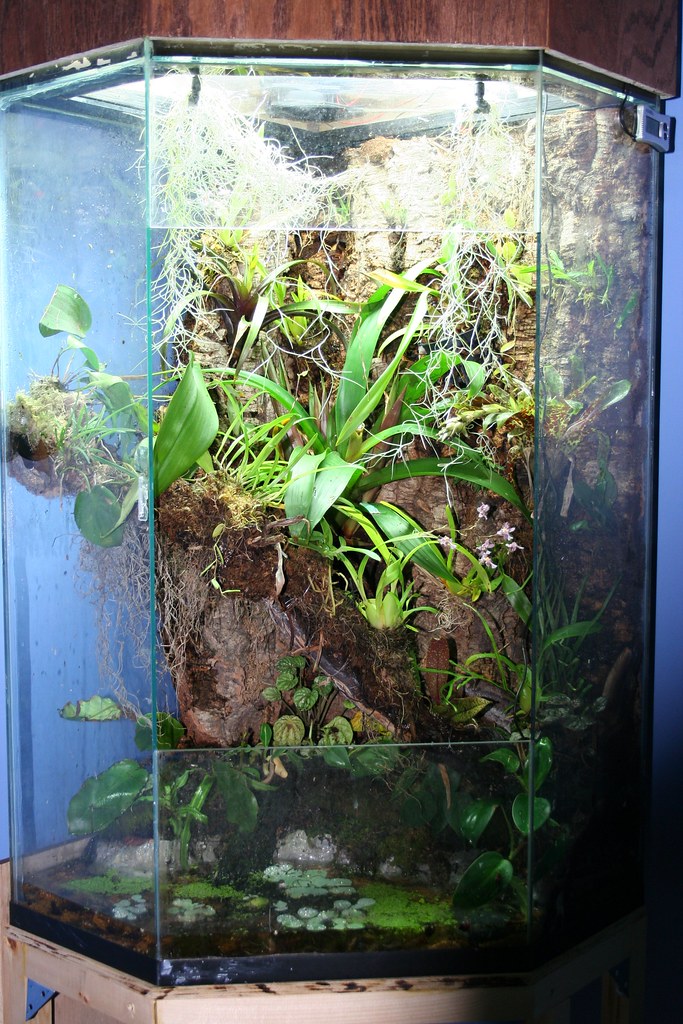
Photo via Flickr, Creative Commons
Detritivores eat dead organic matter rather than living tissue. In a terrarium they occupy the same niche they do on a forest floor: shredding fallen material, grazing fungal growth, and accelerating the return of nutrients to the substrate. They are called a cleanup crew in the hobby, which undersells them — they are the decomposition half of the ecosystem.
A detritivore population turns a sealed jar into a functioning system, and it is the cheapest upgrade available to any build. This guide covers what springtails and dwarf isopods actually do, how to choose between the common cultures, how to seed and feed a population without fouling the substrate, what to do when numbers explode or crash, and which invertebrates are best kept out of a small planted vessel entirely.
What springtails do
Springtails are tiny hexapods, typically one to three millimetres, named for the furcula, a forked appendage they release to jump when disturbed. In a planted vessel they graze fungal hyphae, yeasts and bacterial films, and shred soft decaying plant material.
Their most visible benefit is mould control. The white saprophytic bloom that appears on new driftwood is prime springtail food, and a healthy culture will clear it within a fortnight. That single function accounts for most of their popularity, but the nutrient cycling they drive is arguably more important over a build's life.
They also serve as a live indicator. A visible, active population means substrate moisture and organic content are in a reasonable band. A population that vanishes usually means the substrate has gone too dry, too saturated, or has been contaminated with something — insecticide residue on a new plant being the most common cause.
Choosing a culture
Temperate white springtails, commonly sold as Folsomia candida, are the default. They are prolific, tolerate a wide temperature range, thrive at high moisture, and reproduce fast enough to establish within a month. They live mostly in the substrate and are seen only when the surface is damp.
Tropical pink springtails are smaller and better suited to warm vivariums above twenty-two degrees, where they outperform the temperate species. Silver or 'giant' springtails are larger and more visible, which some builders like as a feature and others find distracting.
For most moss builds, buy a standard temperate culture. They cost very little, arrive in a tub of charcoal or substrate, and one tub seeds several vessels. Avoid taking springtails from garden soil — you will import fungus gnat larvae, mites and slug eggs alongside them, and the trade-off is not worth the saving.
Dwarf isopods and when to use them
Isopods are crustaceans and work at a larger scale, shredding leaf litter and wood that springtails cannot process. Dwarf white isopods, Trichorhina tomentosa, are the standard terrarium choice: three to four millimetres, blind, entirely substrate-dwelling, and tolerant of high humidity.
They pair well with springtails because the two occupy different parts of the decomposition chain — isopods break material into fragments, springtails and microbes finish the job. In a build with meaningful leaf litter, that partnership dramatically accelerates cycling.
Larger species such as Porcellio and Armadillidium are popular in vivariums and are a poor fit for small moss builds. They need drier conditions, a calcium source, and they will graze living moss and delicate foliage when other food runs short. In a twenty-centimetre jar, the damage is immediately visible. Stick to dwarf whites unless the vessel is large and heavily littered.
Seeding, feeding and population management
Seed at build time or within the first few weeks, before mould gets established. Tip a portion of the culture — substrate and all — into a sheltered corner under the leaf litter, and leave it undisturbed. Populations typically become self-sustaining within four to eight weeks.
In a build with litter and normal plant senescence, no feeding is required. If the population needs a boost, a few grains of brewer's yeast or a fragment of mushroom placed on the substrate works, but resist the temptation to feed regularly: uneaten food fouls the substrate and causes exactly the mould problem the crew is meant to prevent.
Populations self-regulate against available food. A visible explosion after adding new wood is normal and subsides as the resource is consumed. A crash usually means moisture at one extreme or the other; check the substrate before assuming the culture failed. If you need to reduce numbers because springtails are appearing on the outside of the vessel, dry the surface slightly and stop feeding — do not use any chemical control in a planted build.
What to keep out
Fungus gnats are the most common uninvited arrival, coming in on nursery plants and bagged compost. Adults are harmless but larvae feed on roots and organic matter, and in a sealed vessel a population becomes self-perpetuating. Quarantine new plants, use a sticky trap, and let springtails compete with the larvae for food.
Snails divide opinion. A small ramshorn or bladder snail in a shoreline build processes algae usefully; in a moss-only vessel they will graze the moss surface and leave visible tracks. Introduce deliberately or not at all.
Mites appear in most substrates and are usually harmless detritivores, though a population explosion signals excess moisture and decaying food. Genuine pests to exclude entirely: slugs and their eggs — a single slug will strip a small build in a night — plus millipedes in small vessels, and anything arriving on wild-collected moss that you have not inspected under magnification. Ten minutes with a phone camera at maximum zoom over new material prevents most problems that would otherwise take months to resolve.
Extended notes
- Springtails are among the most abundant arthropods on earth, with populations reaching hundreds of thousands per square metre in temperate woodland soil. A jar holding a few thousand is entirely modest by comparison.
- Folsomia candida reproduces parthenogenetically, so a single individual can found a colony. This is why cultures establish so reliably from a small seeding.
- If a build must be rebuilt, save a cup of the old substrate. It carries the established microfauna and shortens the new build's settling period substantially.
Frequently asked
Do springtails harm plants?
No. They feed on decaying matter, fungi and biofilm, not living tissue. Damage attributed to springtails is nearly always caused by fungus gnat larvae or isopods that ran short of other food.
How many springtails should I add?
A tablespoon or two of an active culture is plenty for a vessel under twenty litres. They multiply to the level the available food supports, so a large initial seeding buys speed rather than a bigger final population.
Can I keep isopods without springtails?
You can, but the pairing works better. Springtails handle the fine fungal and microbial grazing that isopods do not, and together they cover the full decomposition range.
My springtails disappeared. Are they dead?
Often they have simply retreated into the substrate because the surface dried. Mist lightly and look again the following morning, when they typically gather on damp glass near the substrate line.
Source: Original explainer — Mossline Ecology Desk
Related reading

How a Closed Terrarium Actually Cycles Water, Air and Nutrients
A sealed vessel is a working biogeochemical system, not a decoration that happens to be airtight. This explainer follows water through evaporation and condensation, oxygen and carbon dioxide through the daily photosynthesis and respiration cycle, and nitrogen and carbon through the decomposition pathway, then explains what limits each of them in practice and why the microbial community in the substrate does more for stability than any plant in the vessel.

Light Budgets: How Much Energy a Closed Vessel Actually Needs
Every closed vessel runs on a single energy input, and almost nobody measures it. This piece explains the light compensation point, why duration matters more than intensity for mosses, how photosynthesis and decomposition have to balance for a sealed system to persist, what happens to oxygen and carbon dioxide overnight, and how to work out a realistic daily light budget using nothing more sophisticated than a phone.

Companion Planting: What Grows Well Alongside Moss Indoors
Moss sets the conditions and everything else has to live within them: high humidity, low light, cool to moderate warmth and a substrate that must never be fertilised. This guide covers the small ferns, creeping vines, miniature epiphytes and the handful of flowering plants that genuinely thrive in those conditions, the popular species that are sold for terrariums and should not be, and how to plan a planting so one species does not erase the rest.